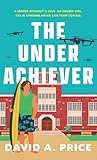
 The Underachiever by David A. Price
My rating: 4 of 5 stars
I was not expecting dystopian when I picked this up from Netgalley, but that's what it is. My relationship to dystopian is like my relationship to kale: I consume some occasionally because I think it will be good for me, but I don't enjoy it.
I enjoyed this one more than most dystopians, though. Even though I'm not a big fan of the slacker/reluctant protagonist either, Wyoming Plankston, the underachiever of the title, is more likeable than most, showing a degree of empathy and a sense of justice that probably isn't common at his elite prep school (for the less intelligent sons of the rich). He's also not as stupid as his grades would suggest, just unmotivated, and he becomes motivated early in the story.
The dystopian aspect is that AIs are ubiquitous, and it's forbidden to share or talk about historical media that goes against the prevailing propaganda that AI is "kind and wise". Wyoming's love interest Kayleigh has made the mistake of doing a presentation involving the Terminator movies, which are classed as Level 3 Misinformation, and as a result has been "deauthorized"; she can't get on social media, ride in an AI-guided car beyond a certain radius of her home (and there are no non-AI-guided cars... or are there?), or use her devices online beyond that same radius.
I couldn't help comparing it with the other near-future AI-centric novel I read earlier this year, Alex Ambler's Rogue by Design: A Department of Misconfigured Intelligence Mystery , in which AI actually is kind, though not wise. Not only is the tone and the attitude to AI (and government) opposite between the two books, but the Ambler book is, to me, more technologically credible - not because the AIs are kind, but just in the general sense that it's written by someone who works in tech and knows how that whole area of human endeavour functions, whereas this book uses AI as a plot device in a way that's been done many times before. Most of the previous examples of using it this way were written before actual AI started being used (if what we have today is actual AI, which is debatable), and that means it's not really true to life. The characters don't use AI, or even technology, nearly as much as I would expect (not even as much as plenty of people do today), for example; Wyoming has to try to remember when a date with Kayleigh is scheduled for, rather than having an AI assistant put it on his calendar, or putting it there himself on his phone. The AIs don't seem to be listening to much, in fact, unless it's deliberately posted online.
Wodehouse is name-checked in the blurb, which is one reason I picked the book up. It wasn't particularly Wodehousian except that Wyoming is more-or-less a near-future American version of a member of the Drones Club - a slacker with an elite education that he hasn't absorbed very well - and there's a reference to the Black Shorts, Wodehouse's parody of the British Union of Fascists, which was as close as he ever came to politics in his books. This version is even more ridiculous, the Black Skorts, and is a pro-AI cult that refers to itself as the "dear cause" (huge red flag). Wyoming isn't very bright, but he's bright enough to see through their fanaticism, and to recognise that the poetry written by one of them, the deputy head of his school, is terrible.
Plus, the Black Skorts have treated Kayleigh badly, and he's all in on Kayleigh. Despite being better looking than he realises and from a wealthy family (although they're currently less wealthy thanks to bad investments by his uncles), he's never actually had a girlfriend before, perhaps because he's clueless and also not an insensitive jerk, so Kayleigh liking him is a big deal; and since Kayleigh wants to prevent the AI apocalypse, Wyoming is up for that too. Even if he has no idea how to go about it.
There are some pretty heavy clues laid down about how he is going to achieve his goal, and I was disappointed by the shape of the solution: (view spoiler).
There are also a few places where things don't quite fit together or aren't plausible, like the characters' phones still working fine after an EMP, seatbelts not being installed in AI-driven cars, or free speech being somehow no longer a thing in relatively near-future America. Again comparing it to Rogue By Design, this book was less realistic, more conventional and tropey, and less insightful about technology, though it was decently insightful about human beings, and I much preferred the prose style. Overall, I rate it four stars, because it's genuinely funny and there are some great lines, but the story has a few holes in it.
View all my reviews


No comments:
Post a Comment