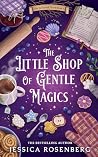
 The Little Shop of Gentle Magics
 by
Jessica Rosenberg
My rating:
3 of 5 stars
I found this one frustrating because it just didn't quite make sense or come across as plausible to me. Someone with a stronger ability to suspend disbelief may enjoy it considerably.
The editing is good (apart from one word choice by the author which I'll point out, when I give feedback to the publisher via Netgalley, is probably not the word she means). But I kept getting tripped up by little oddities in how things unfolded.
Firstly, Meg, the spoiled protagonist. This is a term I came up with for protagonists who get showered with unearned help by everyone they meet. The little Scottish town where this Scottish-descended American protagonist pitches up, a little while after a bad divorce, instantly and unanimously takes her to its heart and begins helping her set up her tea-and-decorated-cookies shop, which she has (unusually for her, we are told) impulsively spent all of her divorce-settlement money on. At least, we're told a couple of times that all her money has gone on buying the lease, but she still seems to have money to spend on fitting it up and getting inventory. It's not clear whether all the tradesmen who are relatives of her neighbours are working for free or just at a discount, but certainly the conveniently-available second-hand shop fittings and kitchen equipment and the tea and baking supplies aren't free. The unconditional help and support, by the way, comes from everyone including the owner of the coffee shop right across the street, who you would think would have at least some thoughts about direct competition for the tourist dollar, but no.
Of course, her new instasoulmate Art (who she met and had one amazing date with in the US, then cut off in a brief message with no explanation because she had to go to Scotland and find herself) moves in with her almost immediately, and is presumably paying something, since his company posted him (conveniently) to Scotland and has an accommodation budget for him, but the question of his contribution to the household finances never comes up. Money in general never comes up, despite the fact that this is probably the number one worry of a new small business owner apart from marketing.
The marketing almost takes care of itself, despite the fact that
on the day the business opens, the shop still doesn't have a name. Art's daughter does some social media stuff Meg doesn't understand, despite being 40 years old in 2026, and they're packed to the doors all day, but Meg can still take time out for interpersonal drama, since the entire community is, as previously mentioned, supporting her.
Meg has grown up being dumped on by her awful mother and aunts because, unlike them, she has no (apparent) witchy powers, and this prepared her to marry an equally if not more awful man who made it all about him, so that she had to completely efface herself in order to manage his emotions for him. But when she starts to finally develop powers (because of the ancient magic of Scotland, which is apparently more magical than America; maybe white people can't access the inherent magic of the land in America?) it doesn't seem to be a big deal for her, as I would have expected. She is worried about telling Art, but of course when she finally does, he's OK with it, because no conflict lasts much more than a short chapter in this book. Even Art's surly teenage daughter is intermittently pro-Meg from quite early on, and his five-year-old son loves her just as instantly as his father does.
There's a good deal of sizzling-hot kissing on page, but no actual sex; it's strongly implied that Meg and instasoulmate just cuddle the first night, and after that it's never directly addressed.
A lot of things are way too easy, and because it's set in a version of the real world, that stands out more than if it's in a lightly-sketched sword-and-sorcery secondary world. At least there are interpersonal (and intrapersonal) dynamics; I wasn't fully convinced by all of them either, but there are some. For example, Art, who is usually a perfect foil for her awful ex-husband, does occasionally make decisions for Meg without consulting her, which she resents, despite, or perhaps because of, the fact that she'd subjugated her own preferences to her ex-husband for 20 years. It seems like these two near-perfect people can only have conflict by both of them acting a bit out of character.
The whole thing is in broadly the mould of all midlife women's paranormal cosies: divorce, small business, new love, discovery of powers, helpful community. It isn't quite what I call This Damn Thing Again, which also involves an inheritance from a relative, returning to one's hometown, discovering for the first time that the supernatural exists, and having a basic mystery to solve, but it's a close cousin. Sure, that's what a genre is, a set of expectations, but this particular genre seems to adhere more closely than most to the exact same setup each time.
Within that setup, for me it didn't come across as plausible. The fiction I admire most starts with a premise - preferably one that hasn't been done a thousand times before - and some well-realized characters and grows the events organically from the setting, the premise and the characters interacting in a natural and believable way. I didn't feel this book was doing that. Maybe I'm wrong, and I'm sure plenty of people will enjoy it a lot, and I do commend the excellent standard of editing. It just didn't quite work for me.
View all my reviews
 The Secret of the Silver Car Further Adventures of Anthony Trent, Master Criminal by Wyndham Martyn