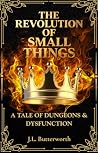
 The Revolution of Small Things: A Tale of Dungeons & Dysfunction by J.L. Butterworth
My rating: 0 of 5 stars
This book is trying to be several things at once: a Dungeons & Dragons-style adventure, a "funny" fantasy, and a left-wing political fantasy. I don't think it succeeds particularly well at any of them, though I didn't read beyond 17%.
In no small part this is because the basic mechanics are extremely rough. I had a pre-publication version via Netgalley, and as always I must note that there may be more copy editing to come between the version I saw and the version that's published, but in this case there's so much work to do that I can't imagine it getting done by... (checks publication date)... yesterday. Yesterday (as I write) was the publication date. No, that's not happening, is it?
There's a comprehensive collection of nearly every common issue, in fact. Vocabulary errors - though not many, at least. Frequent missing or misplaced commas, especially the "let's eat Grandma" error. Misplaced apostrophes. Dialog tags punctuated as separate sentences from the dialog. Dangling modifiers. Two different spellings for one character's name, used more or less alternately. Tense that veers erratically between past and present. Awful attempts at "period" language, which might be deliberate characterisation (the character using it is an idiot), but, given all the other issues, is more likely a reflection of the fact that the author, like most modern people, doesn't know how Renaissance-era English worked.
Not only are there a lot of different types of error, there are a lot of instances of them, too, usually at least one and often two on a Kindle page, which (at the font size I use) is smaller than a printed page.
The setting is standard D&D, including tieflings and dragonborn, which I'm not sure are permitted for use in not-officially-licensed novels as opposed to games; I'm not a lawyer and haven't read all of the Wizards of the Coast license verbiage, though. However, it's a rather depressing version of a D&D setting, full of racist guards who harass an orc just because he's an orc, literally hellish bureaucracy, and corrupt wealthy rent-seekers who think they're untouchable. It's not a tone I enjoy, and along with the constant mechanical issues it was the reason I stopped reading.
The "funny fantasy" part is in the Robert Aspirin mode, which I've never personally found funny: mostly silly names, exaggerated tropes and people behaving like jerks. The locations, for example, are all named after food with some ending tacked on to make them sound like a placename.
It falls both into the "not for me" and "not well executed" buckets, hence my DNF.
View all my reviews


No comments:
Post a Comment