Monday, 13 October 2025

Review: The Luck of the Bodkins

The Luck of the Bodkins The Luck of the Bodkins by P.G. Wodehouse
My rating: 4 of 5 stars

It's hard not to be put into a good mood when reading about the small (but, to them, vital) vicissitudes of Wodehouse's characters. This is classic Wodehouse: multiple couples, who want to marry but can't, for the usual three reasons: 1. Money; 2. Parental disapproval; 3. Misunderstandings between them which mean It's All Off.

Honestly, if I was Monty Bodkin and engaged to the jealous, suspicious, lacking-in-understanding, easily-offended Gertrude Butterwick, and she broke it off (as she does multiple times), I'd consider myself to have had a lucky escape. But he has his heart set on this tough, sturdy hockey-playing beasel, and is willing to go to great lengths, including splashing considerable cash from his fortunately vast stores, to have her end up as his wife.

As soon as we meet Ivor Llewellyn, the motion-picture magnate (older, richer, not particularly sympathetic), we experienced Wodehouse readers know that this is the poor sap who will end up funding the down-on-their-luck young fellows - in this case, the Tennyson brothers, Ambrose and Ronnie - to marry their chosen mates. We also suspect that the resolution will have a great deal to do with his wife's requirement that he smuggle her new pearl necklace through US Customs without paying duty on it, something that would be cheaper than what he eventually ends up doing rather than defy his wife.

A brown plush Mickey Mouse plays the role of Maguffin, there's a random pet alligator belonging to a film star (whose publicist came up with the idea to get her more press coverage), and a talkative cabin steward on the transatlantic liner where most of the book's action takes place is constantly sticking his oar in and providing everything from the equivalent of Shakespeare's "rude mechanicals" scenes to further complications in an already complicated plot, often simultaneously.

The hero, Monty, remarks several times that there are wheels within wheels, and while this is a biblical expression from the prophet Ezekiel, it's also a good description of the book if you think of the plot as being like a highly sophisticated watch with a lot of moving parts that all fit together closely and drive each other. It's a kind of plotting Wodehouse excelled at, all lubricated by a wonderful sense of absurdity and sparkling dialog and descriptions, often drawn from classic English literature.

View all my reviews

Review: The Brick Moon and Other Stories

The Brick Moon and Other Stories The Brick Moon and Other Stories by Edward Everett Hale
My rating: 4 of 5 stars

A collection of interesting and unusual short works.

The title story, "The Brick Moon", from 1869, is the first appearance in fiction of the idea of an artificial satellite, in this case for ships to use as a navigation reference. I'm reasonably sure the proposal, even if the launch had gone as planned, would not have worked, because the satellites wouldn't remain on the north-south line that they were launched on; the earth would turn underneath them, and so, given that the proposal is to launch multiple satellites so that there's always one visible (as is done today with GPS), sailors would have needed a way to distinguish which brick moon they were looking at if they wanted to work out their longitude.

But the story isn't really about that. It's about, first, the coming together of the plan by a group of old college chums with various abilities to contribute, including the one who can persuade audiences without seeming to be eloquent, who helps them raise the necessary funds. Secondly, it's about the building of the first moon - out of brick, as the title suggests - and the flywheels to launch it. And finally, it's about what happens when it's launched accidentally with people in it, since a number of the members of the group and their families are living there temporarily because the brick spheres that make up the larger sphere are quite comfortable. They get flung into space, improbably not turned into jam by the sudden acceleration (which doesn't even wake them up, even more improbably, let alone fling disconnected bricks over a wide area, which is what would probably happen in reality), improbably manage to hold onto their atmosphere through the gravity of their tiny moon, improbably discover that their corn and chickens are evolving into other useful crops and livestock for an unspecified reason - though the several children later born there seem to be normal, as far as is mentioned - and, perhaps most improbably of all, form a utopian society and don't wish to return. It's a historical curiosity rather than a credible piece of science fiction, in other words, but it's pleasantly told for all that.

The author's narrative style is capable of pulling off some unpromising subjects, in fact, and making them engaging. The next story is "Crusoe in New York"; a young carpenter named Robinson Crusoe, asked to fence in a vacant lot, figures out that he could hide a cottage there for himself and his mother, and builds one, proceeding to squat there for 12 years. It brings in a number of elements of the original Crusoe story, but transformed: a footprint in the dirt, "savages" (rough men of New York), and a young Swedish woman named Frida instead of Friday were the ones I spotted, but I'm sure if I had read the original book and not just absorbed bits of it by cultural osmosis I'd have seen some more. The author's note indicates that whole passages are lifted verbatim from Defoe. It's odd that a man so opposed to slavery apparently loved Robinson Crusoe, but people are complicated.

"Bread on the Waters" is a Christmas story, and so of course sentimental, but in a way I personally found moving. An honest and blameless civil servant has to prove that he didn't embezzle some money he disbursed during the Civil War, but the receipts have gone missing, and his family and friends search for them frantically. As the title implies, an old kindness eventually comes back to him.

"The Lost Palace" is a tall tale of sorts, about a group of railwaymen who calculate that they can jump a gorge instead of going the long way round. The "palace" of the title is a Pullman "palace car" or luxury sleeper carriage.

"99 Linwood Street" is another Christmas story, in which multiple kind people come together to help a young Irish immigrant find her brother at the address of the title, which is harder than it sounds when there are multiple Linwood Streets and nearly 100 people with the same name as him. I was moved by this one also.

"Ideals" reuses some characters from "The Brick Moon" and refers briefly to it, but is mainly about four couples, close friends, who get fed up with the weather and the political situation where they live in the US and decide to try living in Mexico. There's a gentle twist at the end.

"One Cent" confused me a bit. The main character drops the change out of his pocket in the dark and a one-cent piece rolls under a table, unbeknown to him. He later gets roughly ejected from a streetcar as a bum because he's a cent short of the fare. While this is happening, letters are on the way to him honouring him for his contributions to his field (ceramics manufacture) and offering him large sums of money. He seems to think that there's a lesson there somewhere, but I couldn't find it; the two things had no causal connection. Perhaps the lesson is that you can't judge someone because they don't happen to have money at the time? It's told in an odd mix of narrative and play format.

"Thanksgiving at the Polls" is the story of a newspaper reporter who decides to save money, and time walking to work, by temporarily living in a street polling booth put up for upcoming elections. He takes in some Jewish refugees from Russia to live there with him (the tone is the opposite of antisemitic, which is a nice change from a lot of older books), and through various charitable institutions and gifts from employers they end up with more food than they need for the Thanksgiving holiday and go looking for people to share it with. There's a theme of "we could look after the poor better, all year round" running through the whole story.

"The Survivor's Story" is clearly inspired by Chaucer; four couples (this seems to be a thing with Hale, and I assume reflects his actual friend circle) come together at Christmas away from home and tell each other stories. There's an odd ending, which suggests he didn't know how to end it properly, and is out of keeping with the general tone.

In what is, strictly speaking, original research, Hale's Wikipedia article notes (at time of review) "Hale was active in raising the tone of American life for half a century." I can well believe it. His stories are humane, kindly and warm - although people do die in them for no particular reason sometimes - and their manner is more important than their matter. They remind me of Mark Twain in their style, although without Twain's occasional cynicism and misanthropy.

Recommended, and I would read more Hale.

View all my reviews
Friday, 10 October 2025

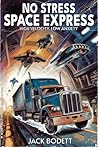
Review: No Stress Space Express: A Cozy, Low-Stakes, Slice-of-Life Adventure

No Stress Space Express: A Cozy, Low-Stakes, Slice-of-Life Adventure No Stress Space Express: A Cozy, Low-Stakes, Slice-of-Life Adventure by Jack Bodett
My rating: 4 of 5 stars

This isn't really SF. It's a gentle comedy with some SF set dressing for atmosphere. Kind of what you'd get if Douglas Adams had grown up in the southern US instead of England, only less so. Like its main character, it's kind of dumb, but so amiable that you don't care too much.

Two truckers break down by the side of the highway, and get accidentally abducted by aliens, who have ordered the load of whoopee cushions they are hauling in order to use them in a religious ceremony. On the alien ship, they meet a hot green Martian woman who was the victim of a similar misunderstanding, and ally with her to start a repair business for alien tech, which somehow they're able to figure out. Later on, another Martian woman joins the group.

The worldbuilding is often rudimentary; space is like the 21st-century USA a lot of the time, except when it's conforming to a well-worn sci-fi trope. Many people speak a language that's independently evolved on multiple planets that's almost indistinguishable from contemporary English except for a couple of amusing quirks, there's coffee, and it's served at a diner, where the robot waitress is very much like a stereotypical southern US diner waitress. Spaceship engines are also almost indistinguishable from truck engines; they have liquid fuel in lines which can be bled without special precautions, you can idle them, and they roar. There's a bit at the beginning where the alien written language (or, at least, an alien written language) is incomprehensible, but later on, the alphabets for the English-equivalent languages have apparently evolved to be the same as ours as well, because Rusty, the narrator, has no issues reading a manual for a spaceship engine. (view spoiler)

Funnily enough, I recently read an early work of SF ( A Honeymoon in Space by George Chetwynd Griffith) in which there was also a Martian who spoke a language that had evolved to be exactly like English, only Griffith, being Griffith, managed to make it racist, or at least chauvinist; English, being the best language (as proved by how many people on Earth had adopted it), would naturally be the language that a hyperrational and optimised society would evolve, he says.

Having studied the process by which English came into being, I can tell you that it couldn't happen twice - once was unlikely enough (and if a hyperrational society evolved an optimised language, English would definitely not be it). But in this book, it's just a workaround to remove issues of communication between the characters, and it's in the context of a humourous setting that doesn't take its worldbuilding remotely seriously, so I'll let it slide with just a healthy dose of side-eye. To be fair, in the Marvel Cinematic Universe, everyone in space speaks English and nobody even remarks on it.

The editing is surprisingly good for this kind of book. Yes, there are too many hyphens (between an adjective and its noun sometimes, and in numbers that aren't between 21 and 99), and sometimes missing hyphens where only the first two words of a three-word adjectival phrase are hyphenated. Yes, there are a few too many commas between adjectives, but there are very few authors, even good ones, who don't make that mistake. It needs another scan for missing punctuation, like closing quotation marks. Otherwise, it's much cleaner than I'm used to. By sticking to his own vocabulary, the author has managed not to commit any vocab errors, for example, apart from "hear, hear" being spelled "here, here."

Apart from the almost aggressively undercooked worldbuilding, its big fault, from my point of view, is that it has no chapters - or rather, it has just one long chapter which rolls on from incident to incident without pausing. This isn't ideal when you don't have time to read it all in one sitting. It does finish up with some significant events that change the situation of the characters, ready for the next book in the series, so it isn't one of those serial stories that just arbitrarily stops at a word count.

The humour lies mostly in folksy imagery ("tugged in more directions than a dog walker at a squirrel convention") and good-natured banter. It manages to be funny without trying too hard, which is always a risk in humourous writing. All the aliens the characters meet are nice and helpful and generous, and it's exactly what the subtitle says it is: a cozy, low-stakes slice-of-life adventure (the subtitle also has a comma it doesn't require). It's a pleasant read, and I wouldn't mind reading more in the series, though it has enough faults that I wouldn't pay full price for them. It's pleasant, but the building of the world is so low-effort that it reduces my desire to spend time there.

View all my reviews

Tuesday, 7 October 2025

Review: A Honeymoon In Space

A Honeymoon In Space A Honeymoon In Space by George Chetwynd Griffith
My rating: 3 of 5 stars

A turn-of-last-century piece of early speculative fiction, offering a tour of the solar system as it was then conceived (more or less; the author's grasp on science, even the science of the day, was not always firm). This makes it a "planetary romance," like Barsoom, C.L. Moore's tales of Mars and Venus, or Lewis's Space Trilogy (the latter a very late example of the form). It wouldn't at all surprise me to learn that Lewis had read it, though his Martians are completely unlike Griffith's, and his Venus, while also an unspoiled Eden, is also significantly different.

The hero is an engineer who has built an interplanetary ship powered by basically Cavorite (though I don't think he was copying Wells, whose The First Men in the Moon came out the same year), and uses it to take his newlywed wife on a tour of the Solar System. In line with the author's first book, The Angel of the Revolution: A Tale of the Coming Terror , as the only possessor of the technology of flight, he's in a position to dominate the earth and make everyone behave themselves, and uses this to stop World War I from breaking out early (with different alliances) before departing for his honeymoon.

It's shot through with all the prejudices of its time and its author. The engineer-hero patronises his new wife (daughter of the scientist whose designs he has realized, a couple of years after the professor's death) abominably. He repeatedly calls her "little woman," even though it's established in one scene that she's almost as tall as he is, and he's a tall man. She's one of Griffith's educated women, who's both celebrated for her intelligence and put in her place, similarly to his The Mummy and Miss Nitocris: A Phantasy of the Fourth Dimension , which I read recently.

The British Empire is a jolly good thing, hurrah, and Englishmen are the best, with Americans only a little bit inferior (the wife is American). When they reach Mars, there's a lot of dialog about how the Martians, under the pressure of their dying world, have become super-rational and no doubt reduced their "lesser races" to servitude or else eliminated them, as will happen on Earth some day; both of the travellers are highly indignant that the first response of the Martians is to shoot at them, which of course English or American people would never do with strange visitors. The most ludicrous moment of the whole book is when they can understand the Martian leader because, since English is the best language, the Martians have naturally come to speak something almost exactly like it as part of their evolution towards rationality and optimisation.

They consider themselves fully justified in mowing down a bunch of the nasty Martians with Maxim machine guns, and depart for Venus.

The Venusians are unfallen angels of sorts, and although they'd love to stay there, even these two egotists recognize that they'd only spoil the place. One of Jupiter's moons has an advanced and friendly civilization - the humanoid form is, of course, what everything evolves into if it's going to be intelligent - and Saturn is full of monsters.

Finally, they barely make it home, through one of several coincidences that save their bacon by celestial bodies being in the right place at the right time to assist their antigravity drive.

Apart from his various storytelling weaknesses, the author makes two big scientific blunders. First, he assumes that because a (very slow-moving) balloon doesn't throw you around when you fly in it, nor will an extremely fast-moving spaceship. Before Einstein (or maybe before actual aeroplanes), people don't seem to have had much of a grasp of acceleration and how it worked. The other blunder is that as they approach one of the gas giants - I forget whether it's Jupiter or Saturn, I think Saturn - he gets phases completely wrong. As he presents it, the planet goes through its phases rapidly because of the rotation of the planet, whereas in fact it's the angle between the observer, the sun, and the celestial body that produces phases, as he ought to have known if he thought about the moon for even a minute.

In summary, it's not good, though interesting as a sample of how people thought about the Solar System (and humanity) a hundred and twenty-five years or so ago.

View all my reviews

Review: Lucian's True History

Lucian's True History Lucian's True History by Lucian of Samosata
My rating: 3 of 5 stars

Classic proto-SF, and a probable ancestor of many a fantastic voyage narrative, from St Brendan to Gulliver to Sinbad to the Dawn Treader - though it drew on earlier travellers' tales, and notably on Homer, who Lucian greatly admired and constantly referenced, and who is even a character in this story. It's also arguably among the first works of fiction, though, and the differentiation it explicitly makes between itself and those earlier tales is that the author states upfront that everything in it is made up and a complete lie. It's not presenting wild speculation as authentic chronicle, but as the fiction it always was.

And the speculation is wild. The travellers, led by the first-person narrator, sail beyond the Pillars of Hercules into the Atlantic, and get caught up into the air by a freak wind, landing on the moon. The moon people are at war with the people of the sun over wanting to colonize Venus, and the travellers take part in the war, on what turns out to be the losing side (because of late reinforcements of centaurs). They're ransomed, though, and the king of the moon offers to marry the narrator to his son, which the narrator refuses. The people of the moon have no women; instead, the men under the age of 25 receive the seed of the older men in their thighs, where they gestate the children. (I assume this was satire on the then-common practice of older men having younger male lovers.)

They leave the moon, and have further adventures, including being swallowed by an immense whale, miles in length, and eventually killing it by setting the trees growing inside it on fire. They come to an island where the Elysian Fields (the Greek afterlife) can be found, and speak with famous people including Homer, some of whom are satirized. In this afterlife, men openly have sex with both men and women, and nobody thinks anything of it, and the women are "in common," but this doesn't stop some of the men being jealous about their wives.

The ruler of the realm of the dead tells them they have to leave, since it's not yet their time to be there, and they eventually make it back home, via Circe's island (the narrator carries a message from Odysseus to Circe, which he's careful not to let Penelope see).

The more you know about ancient Greek literature and culture, the more you'll get out of this, I'm sure, because there are a good few name-drops that I had to look up. But even a superficial knowledge will get you by, and it's interesting as an early example of fantastical fiction. I'm not quite ready to add it to my annual recommendation list, though; it's a bit niche for that.

View all my reviews

Thursday, 2 October 2025

Review: The Land That Time Forgot

The Land That Time Forgot The Land That Time Forgot by Edgar Rice Burroughs
My rating: 3 of 5 stars

The nonsense racist pseudoscience is strong with this one.

A dastardly World War I German U-boat commander attacks the hero's unarmed civilian passenger ship (with US registry, and I don't think they were in the war yet, so it's neutral shipping) and sinks it, shelling boats with women and children in. The hero survives and rescues his dog and also a young woman, and they are picked up by a British tug - which is then attacked by the same U-boat. The brave tug captain chooses to ram the U-boat and then his men fight the Germans hand-to-hand, capturing it at the cost of the lives of the captain and several crew.

It turns out that the young woman's fiancé is the U-boat commander, but it was an arranged marriage. Fortunately, the hero's father's business is building submarines, and they built this one, so he can take over command.

Then we get a long series of misadventures that end up taking them into the Pacific and all the way down almost to Antarctica, thanks to assorted villainy. (view spoiler)

They are running low on fuel and water and well out of their course, and then (about halfway through the book) they come across the land of the title, a large volcanic island with unscalable cliffs all round and just one river discharge, through caves that can only be navigated by submarine. Fortunately, they have a submarine!

(view spoiler)

This isolated place has a tropical climate (from the volcanic heat, presumably) despite being near Antarctica, and was probably the model for the Marvel Universe's Savage Land. It's full of otherwise extinct creatures from every era and continent, dinosaurs, plesiosaurs, pteranodons, sabre-tooth tigers, cave hyenas, you name it. It's like the Swiss Family Robinson's island, but with palaeontology.

It also has various apes, ape-men, and primitive humans, which is where the racism comes in; the less developed ones, of course, are "negroid" in appearance, even though their skins are white, and that disappears as they become more advanced. This seems to happen in the lifetime of an individual, with people heading further north and adopting more technology as they evolve (or rather metamorphose) in the direction of modern homo sapiens. It also seems to have something to do with the pools in which they bathe - I bet it's radium, that would fit the science of the time. Piltdown Man gets a name-check, being still believed in at the time of publication (1918), and not exposed definitely as a hoax until the 1950s.

It's all a bunch of nonsense, of course, with the flimsiest scientific backing at best, but it's mainly there to be a backdrop for the adventure - and the romance, such as it is, between the hero and the woman he rescued.

There were a couple of sequels, which apparently follow very similar lines to the second part of this book, and it wasn't good enough for me to want to read them. I didn't expect much from Burroughs, a pulp writer among pulp writers, and I didn't get much. The adventure parts are the best parts, of course, and if you're just reading for that, it's OK, but nothing else is very good at all.

View all my reviews

Wednesday, 1 October 2025

Review: The Mummy and Miss Nitocris A Phantasy of the Fourth Dimension

The Mummy and Miss Nitocris A Phantasy of the Fourth Dimension The Mummy and Miss Nitocris A Phantasy of the Fourth Dimension by George Chetwynd Griffith
My rating: 4 of 5 stars

I've recently loaded up my e-reader with a large selection of early science fiction and fantasy titles from Project Gutenberg, after a binge on classic mysteries from the same source. I've often steered clear of early SFF, because it has, let's say, very different strengths from current SFF - it might as well be a different genre in many ways. But there is some good stuff out there - I know, from having read some now and again - and I'm going to explore and see if I can find some more.

The thing about reading hundred-year-old fiction is that the preoccupations and the tropes and the stock characters are very different. (And the prevailing ideologies, naturally.) Anything involving science, too, is liable to involve what we would think of as pseudoscience. That's certainly true of this one.

The central characters are an English professor of mathematics and his daughter, who he named Nitocris after an ancient Egyptian queen, since he's a keen amateur Egyptologist. But it turns out that she is in fact the reincarnation of the ancient queen, and he is the reincarnation of a priest who fell in love with the queen (don't think too hard about them now being father and daughter, or things will become more like ancient Egyptian royalty than modern minds are generally comfortable with) and helped her avenge herself on the murderer of her husband. Of course, the murderer and his associate, another priest, have also been reincarnated, and set out to play their villainous role over again.

Meanwhile, though, the professor, musing on a proposition of Euclid, comes to a gnostic realization of the nature of the fourth dimension, which gives him superpowers. He can become invisible, see into the past and great distances away, and so forth. He confounds his learned peers and rivals by demonstrating three supposed impossibilities: trisecting the triangle, squaring the circle, and doubling the cube (all of which, by that point, had been proved to be impossible with the ancient tools of compass and straightedge, though mathematical cranks continued to try). And then Nitocris, his highly intelligent and well-educated daughter, is raised to a knowledge of her heritage and gets superpowers too, and they decide to use them to solve the mystery of the disappearance of a possible future elective Tsar of Russia, depending how the revolution goes (this is 1906, a couple of years before World War I and several more before the Bolshevik victory). Of course, one of the villains, the reincarnation of the murderer of original-Nitocris's husband, is involved in that disappearance; he's a rival for the imperial throne. His sidekick, the reincarnation of the wicked priest, performs wonders similar to those performed on the music hall stage of the period, some of which were rumoured to be performed by Indian fakirs, but does so out in the open and in the middle of a circle of scientific skeptics, to their extreme annoyance and puzzlement.

Meanwhile, Nitocris wants to marry a naval officer, which her father (who, like many intellectuals of the time, believes in eugenics) opposes, being bitterly opposed to war and warriors. She also manages to pair up an unsuccessful suitor of hers with her American friend, who's the daughter of the professor's chief rival - though the two academics are friends of a sort when they're not trying to tear down each other's arguments.

So, we have: reincarnation (presented by the author as if it was a pretty obvious truth), superpowers arising from the understanding of abstruse mathematics, mystery, international politics, academic politics, two romances, and the plot of the reincarnated villains against the reincarnated Nitocris and her priest, now father. All of these are intertwined like a ball of snakes.

It's a complex way to approach a plot, and should only be attempted by experienced authors. This one, I think, largely pulls it off; he was at the end of his life when he wrote it, and although critics considered his powers were waning (under the influence of alcoholism, which killed him), he does juggle and intertwine the various strands capably. Having so many of them does mean that some remain underdeveloped, notably the romance subplots, which barely get any time devoted to them - not only on the page, but in the lives of the participants. The disappearance and reappearance of the mummy of the title is never explained in any way whatsoever; it just falls under "a wizard did it".

He's not the greatest prose stylist, and his characters and descriptions can be thin and stereotyped. Nitocris, for instance, is simultaneously a nice early-20th-century Gibson girl from a prosperous English background and a ruthless ancient Egyptian, and the contrast is sometimes jarring, because neither side of her has much depth, and so it's simply a contradiction with no bridge in the middle. Griffith also shares the usual anti-foreign bias of his time; practically anyone who's not English is automatically and obviously a villain, with an exception granted for the Americans (who are, however, portrayed as odd people talking a slangy dialect). He conveys the distinct impression that simply by being born English, the professor had taken a big step up from his previous incarnations.

Overall, it's an interesting idea but a less-than-amazing execution, and just makes it into the lowest tier of my annual recommendation list.

View all my reviews