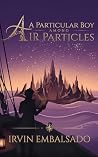
 A Particular Boy Among Air Particles by Irvin Embalsado
My rating: 0 of 5 stars
The author has set out, I think, to produce a book in somewhat the style of Brandon Sanderson. The difference is that while Sanderson's worldbuilding always has some off-the-wall aspect to it, he always manages to make that difference, and the rest of their world, feel plausible, while this one never achieved that as far as I was concerned.
It's set on a very small world. There are six landmasses, described as "continents," but the smallest of them can be seen all at once from a hot air balloon, and they're no more than a day's boat journey apart, so to my mind they would be better described as an archipelago of islands. (I live on a moderately large island. You can't remotely see all of it at once even from a high-flying aeroplane.) The boat in which Cielo, the protagonist, tours this world is a lifeboat from a larger vessel, but carries enough fuel to get to all the "continents." Why would this be, when nobody ever visits another "continent" because each society has everything it needs locally, and a lifeboat would only ever need to get back the short distance to its home "continent," and for that matter there are never incidents at sea that would even require a lifeboat? The only answer I can think of is "so the story can happen," which is never a good answer.
What's more, those societies themselves make little sense. One, for example, has a decaying punk-rock city in which people seem to spend most of their time high and either listening to music or driving round in "smoke-belchers." There's no indication of how food, or drugs, or smoke-belchers, or amplifiers, or electric guitars, or lights are produced, or by whom, but maybe it just all happens offstage (literally). Oh, there is an indication of how some food is obtained: they eat rats. On skewers.
All of the societies seem cartoonish and incomplete, despite the assertion that all of them have everything they need without each other. This assertion, by the way, is delivered in infodump by an intrusive narrator who sometimes speaks directly to the reader, but who then mostly takes a step back for the rest of the book. The bulk of the narrative is indistinguishable from close third person following Cielo, except when it suddenly hops into the head of his friend O.G. briefly. There are a number of instances of what would, in close third person, be POV violations, such as casually naming cultural features that the writer and the readers would recognise but Cielo should not, or naming characters he meets before they introduce themselves.
The worldbuilding wasn't the only part that didn't make sense to me, either. There were multiple moments when I thought there was an obvious action for Cielo to take - such as (view spoiler) - but he doesn't, I assume because the predetermined plot and the idea of him as a lone hero took precedence.
We do eventually learn why this world is like it is, and it then kind of makes sense, but it's still pretty fanciful, and I didn't buy in. Still, the characters are just appealing enough, and the emotional beats strong enough, that the story held together and kept my interest, even if it reminded me more of Alice in Wonderland or the Phantom Tollbooth than Tress of the Emerald Sea.
The Netgalley pre-publication version I had was also reasonably well edited, apart from missing the past perfect tense occasionally when talking about something that had happened before the narrative moment.
It does have strengths, but for me they're outweighed by the inconsistent POV and the implausible worldbuilding, and it ends up at three stars.
View all my reviews


No comments:
Post a Comment