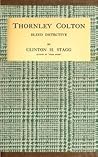
 Thornley Colton: Blind Detective by Clinton Holland Stagg
My rating: 3 of 5 stars
Not the first blind detective (as far as I know, that's Ernest Bramah's Max Carrados), but very much in the same tradition as its predecessor, with the trope of the blind man who has developed his other senses to an extraordinary degree. He can read written or typed pages (or music manuscript) by feeling the back of the paper with his fingers, for example, and has particularly keen hearing. He can somehow grab accurately for someone's arm or otherwise know exactly where they are and in what position, which comes up on more than one occasion, and some people refuse to believe he's actually blind. He himself sometimes lectures about how people with sight are deceived by it, while he is not, because he interprets everything in a situation and makes a mental model of it and how it must have been.
It's clumsy at times. For example, in the first story, someone - in dialog - mentions Colton's secretary Sydney Thames and says his name is "pronounced like the river" - which would be obvious, since he'd just pronounced it. It would have been more natural to say that it was "Thames, like the river." There's a reason for the name, repeated in each of the stories (which I assume were published individually in magazines before being collected): Colton found Sydney Thames as a baby, abandoned on the banks of the London river, and adopted him. He's also taken on a young New York lad - the stories are set in New York - who's known as "Shrimp" or "the Fee," because he was the only payment received for solving a murder, of Shrimp's mother by his father. The boy is very keen to imitate his two heroes, Colton and the fictional Nick Carter, and gets as involved in Colton's cases as his guardian will allow, sometimes putting himself in danger as a result.
The openings of the stories are usually a flight of descriptive prose in the style of the time, a bit overwrought and melodramatic for modern tastes. Having set the scene, the author brings Colton into it, usually by pure coincidence - he just happens to be in the vicinity when the crime is committed - but sometimes because he's called in by people who know his reputation as a "problemist," which is what he calls himself rather than a detective. He's independently fairly wealthy, and doesn't need to have a profession or charge fees, but solves problems for the sake of the interest he takes in them and also for the good of the victims.
He places a high value on human life, though he sometimes causes innocent people emotional distress in the course of setting traps for the criminals, often to the dismay of his secretary Thames. The secretary is overawed by beautiful women, and becomes anxious in their presence, and if Colton seems to be harsh with them he protests, despite regarding Colton as a father figure.
It's tropey and sometimes ridiculous, uses some terms for various races that were common at the time but are now regarded as deeply offensive, and isn't written in the best prose I ever saw. But it's lively and vivid, the characters aren't all simply stock, and the mysteries are cleverly worked out. It has enough flaws that I put it down to three stars, but it's a high three.
View all my reviews


No comments:
Post a Comment