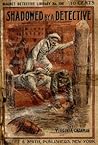
 Shadowed by a detective, or, The woman in wax by René de Pont-Jest
My rating: 3 of 5 stars
The Street and Smith edition, on which the Project Gutenberg text is based, doesn't acknowledge it, but rather than being an original work of the credited author Virginia Champlin, this is a translation from the French book La Femme de Cire by René de Pont-Jest. It should be obvious to anyone who's read translated French works of the time; the New Yorkers don't talk remotely like New Yorkers, but in a way that seems to translate the French fairly literally, and the New York police department (and the private detectives, who are variously described as a firm of lawyers and "secret police") don't work like actual American police/detectives. Their titles, their duties, and whether they are elected or appointed (and are or are not lawyers, and are or are not described as "magistrates" - both the "chief of police" and the out-of-place New York sheriff are so described) are all at variance from actual practice at the time. The whole inciting incident also feels very French, with rivalry over a woman leading one of her suitors, an otherwise staid American businessman, to make extravagant statements about duels and murdering both his rival and the woman, and then fall into a decline where he's barely able to speak. Even the names are often just slightly off for being American names. For example, the main suspect rejoices in the name of Gobson. Not Gibson or Dobson, but an unhappy amalgam of the two.
The book is set in the late 19th century; references to someone being in "the Union army" suggests around the time of the Civil War, though the original publication date was 1883, so perhaps this is just another example of the French author not being aware of terminology and the translator not fixing it.
Ada Ricard, the beautiful widow of a wealthy man, is being courted by another wealthy man, a cracker magnate, who is showering her with expensive gifts. However, the army officer alluded to above is determined to win her, and arranges for her to be abducted (with her ready cooperation) from a masked ball at her mansion. A few days later, a body of a young woman turns up in the harbour, bearing the distinctive marks inflicted on Ada by her violent first husband, whom she divorced prior to her marriage to the late wealthy man. Someone has killed her and then attempted to dispose of the body in the sea, weighting it down with a barrel of tar.
The question is: is this actually Ada? Her maid says maybe not. Her ex-husband says definitely not, (view spoiler)
There's a whole sting operation, and finally the detective, a doctor who has (for reasons left mysterious) volunteered to become a New York police detective, and (for reasons also left mysterious) adopted a sixteen-year-old girl who's said to be his distant relative, closes the case in dramatic fashion.
The whole thing must have been very confusing to American readers of the time, since not only do the police and the courts not work the way they actually worked, but everyone behaves as if they're French, making dramatic declarations and fainting in moments of high emotion and threatening each other's lives and, of course, planning to commit adultery at the drop of a hat. Mrs. Gobson's first thought when she learns that a 40-year-old man and a 16-year-old girl are living next door is that they're on their honeymoon, and she's jealous.
If you set all the nonsense aside, it's not a bad story, if a bit melodramatic, but it's very much "watch the detective do odd things and then, at the end, explain them, introducing information that the reader had no access to at any point." It's just OK, and it's also a cheaply done (and intellectual-property-rights-violating) piece of publishing. Of course, Street and Smith boast at the front of the book about the enduring quality of their publications, which always raises red flags for me (it's something HarperCollins does today in some of their incredibly poorly edited, rushed-out scans of century-old books).
View all my reviews


No comments:
Post a Comment