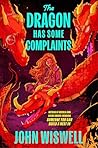
 The Dragon Has Some Complaints by John Wiswell
My rating: 2 of 5 stars
I also have some complaints.
tl;dr: This book was not for me. I mean that both in the sense that I didn't like it much, and also in the sense that it wasn't intended for the kind of person I am.
If you're the kind of person who will love this book, or have already read it and loved it, reading this review may only annoy you, and you may be better off skipping it and reading one that will reinforce your views instead. I always implicitly write my reviews for people who value the things I value (writing craft, especially) and enjoy the things I enjoy. I write positive reviews to direct them towards books I think they would like, and negative reviews to direct them away from books that are probably not going to be to their taste. If you have different priorities and enjoy different things, what I have to say will not be of much interest to you.
This review is going to be as much an expression of concerns I have about the current cozy fantasy genre in general as it is about this book in particular, though starting from thoughts I had while reading this specific book.
The first thing that bothered me about this book is that it feels like one long point-of-view violation. The viewpoint character is the relatively sane and sensible central head of a three-headed dragon; the other two heads have issues. Upperhead has the delusion that he's human, and Lowerhead has become almost animalistic. All three, including Centerhead, have lost memories because of the trauma of the loss of Lefty, the fourth head, who was favourable towards humans and worked with them. That obscured backstory may partially explain why this supposedly wild dragon not only understands but freely uses so many human concepts, including trans men and women (who he identifies instantly as such), cathedrals, apothecaries and vacations -this last itself being an anachronistic concept for the setting. However, while he recognizes ink and paper, he doesn't understand what writing is - but uses the verb "read" in a metaphorical sense multiple times.
How this came across to me is that the author wasn't putting in the effort, or maybe didn't even think about the need, to characterize someone based on what that sort of character is familiar with and would know and value. Reading some of the reviews of one of his other books reinforces this idea; multiple reviewers mentioned how a solitary swamp monster who had previously had limited and brief interactions with humans seemed to have a complete and instant grasp of how abusive human relationships work, as seen through a this-worldly current-state-of-psychology lens. To me, this is a basic craft issue.
And this is a problem I have with the cozy genre in general. Not only is the worldbuilding often thin, little more than generic sword & sorcery scenery flats, but those scenery flats stand behind people who are, in their attitudes and ways of thinking, completely indistinguishable from mid-2020s US people of a particular type (to which the authors belong). My suspicion is that they are so embedded in a filter bubble that emphasizes doctrinal purity that they are almost unable to conceive of people who might think differently from them, except as othered and villainized; that they have no functional sense of history; and that they believe implicitly that everything they think, and the way they behave, cannot be improved upon and therefore should be universalized. As a young person, I was in a community like this myself, and even though the content of the beliefs could hardly have been more different, I recognize the patterns.
In the typical cozy book, basically every single character (who isn't a villain or at least an opponent) is queer in some way, and most of them are at least one of neurodivergent, disabled, or struggling with anxiety or depression. In these days of self-selecting groups ("found family"), this may be the lived experience of the author; everyone they know is like this. But it's like the famous example of the journalist who, when a political candidate won an election, protested that nobody he knew had voted for him. It says more about the narrowness of the person's experience than the actual constitution of the world at large. I should note that I don't have a problem with people being queer, neurodivergent and etc. These are ways that real people are. But it isn't how everyone is, and universalizing it places me and people like me, who don't have those characteristics (except that I am arguably slightly disabled and occasionally anxious), in an outgroup, just as much as earlier literature placed people who did have them in an outgroup. It's not true inclusiveness if there's still an outgroup, even if that is the people who were traditionally the ingroup. It's still not fully honouring our shared humanity.
In this particular book, the pervasiveness of these types of characters is more or less its only claim to belong to the cozy genre, since it's about a war between diverse refugees from a lightly sketched fascist-imperialist country and that country's military. Nobody here is living the equivalent of a Japanese "slow life." It's more like the demimonde of the Weimar Republic left Germany (though the names are mostly Eastern European), found an uninhabited island, tamed some dragons, created a flying city using the antigravity magic of the dragons, and held out against a much-less-efficient Nazi regime, with Britain pretending to help, but actually out to take half their land and half their dragons in return for minimal assistance. (That is, at least, slightly more worldbuilding than cozy authors often bother with.)
The other thing that annoyed me about this book, and the main reason I gave it up in the middle, is the character Raina, who becomes the rider of the dragon central character. She is the complete opposite of the kind of character I like to read about. She's outwardly naive and optimistic to the point of getting on people's nerves, while on the inside she's a complete emotional bombsite who uses alcohol and casual sex as forms of maladaptive coping. And what escalated her from "annoying character" to "reason to put the book down and not pick it up again" was that the dragon declares to Raina that she is everything a human should want to be, which is a statement I couldn't disagree with more strongly. To me, that's not unconditional acceptance; it's enabling.
If you don't care about the POV issues and can cope with Raina, this is a competently written book with the right emotional beats to appeal to plenty of readers. In the author's afterword, he mentions that the copy editor remarked on how clean it was, and I agree that it has fewer issues than average, but there are some words used in odd senses, and a few small words like "to" and "the" dropped out of the occasional sentence in the pre-publication version I had from Netgalley. (Missing words are a hard thing to spot unless you have the knack of it.)
It's not a terrible book. It just very much is not for me.
View all my reviews


No comments:
Post a Comment