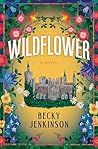
 Wildflower: A Novel by Becky Jenkinson
My rating: 3 of 5 stars
The worldbuilding is not a strength in this one, which isn't unusual in its particular type of current fantasy, but I felt the story was solid.
The character names are a classic "Aerith and Bob" situation, some of them botanical or otherwise nature-related, some of them from various origins in our world (including several from the Bible, in a setting where religion is conspicuous by its almost total absence and where the two brief passing references are to Standard Fantasy Paganism), and some completely made-up fantasy names, with no obvious schema to account for the mixture. The characters themselves mostly feel like mid-2020s people cosplaying (or, in at least one scene, just wearing modern clothing) in a generic ren-faire setting, and the setting itself feels too small, with places that seem like they ought to be a long way off instead being in easy walking distance. The review copy I had didn't have the map yet, but based on the travel times mentioned, the whole kingdom is about the size of the six boroughs of New York City (roughly 35 miles across). And yet a character who has long wished to visit a wonderful library just to the north has never found time to make the two-hour journey by horse (meaning about 10 or at the most 15 miles), and an afternoon's walk from the citadel, which occasionally gets snow flurries, takes you not only to but also up a mountain with a permanent snowcap and blizzard weather. The small size of the kingdom presumably accounts for the fact that, although there's a royal family (consisting of a king, a queen, and two princes), there doesn't appear to be an aristocracy, and both the queen and the older prince's fiancé are commoners.
The flower lore is interesting, though it has an obvious real-world model in the Victorian "language of flowers". It's the most original part of the worldbuilding.
The magic system is largely undefined, and what it can and can't do appears to be driven entirely by what the plot requires.
On the upside, even the pre-publication copy I received via Netgalley for review was well edited, apart from the occasional dangling modifier, fumbled idiom or clumsy phrasing, and a few cases where two words that are not synonyms are used as if they are. The emotional beats are sound. The plot is a proper plot, not just a slice of life, and it's driven by the decisions of the characters, some of which are bad ones such as real people make, and they make them for believable reasons. It's cozy in its presentation (after all, it's about a magical florist), but it has stakes and tension and losses and tragic backstory and desperate struggles and a strong climax.
The main character, Felicity, was born with a curse which prevents her from saying anything that isn't the truth. The rules seem to change a bit during the book; at one point she can say something that is her opinion, even if it's not commonly shared, but later on it's as if the very fact that she can say something means it's definitely true. Can't she be mistaken? Of course, this is also the point at which people stop believing her, because she's saying things they don't want to believe.
The queen has been using her as a snitch, which has made her unpopular, but when we see her being interviewed by the queen she's perfectly capable of concealing a lot of information, so that's a tell-versus-show mismatch, what I sometimes call a decal.
Perhaps the biggest strength of the book is that it depicts Felicity's inner life so well. Because she's unpopular for her truth-telling, she tries to be reliable and compliant and trustworthy and non-confrontational and a people-pleaser, and stuffs her feelings down and lets people walk all over her (like her only friend, a rather self-involved extravert who strongly reads "bard," though I don't think he has an occupation other than "prince's fiancé"). All of this starts coming apart quite early in the book, so we're, again, more told about her people-pleasing than we are shown, but it is emotionally accurate to someone who is this way. There are some highly emotional scenes, for Felicity and her love interest both, but they're justified by events and not just the characters being over-dramatic.
Emotionally sound writing balanced by basic and unconvincing worldbuilding and some elements that didn't ring quite true brings this in at three stars. A lot of people who don't demand much from worldbuilding will love it unreservedly, I'm sure.
View all my reviews


No comments:
Post a Comment