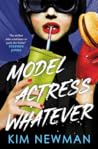
 Model Actress Whatever by Kim Newman
My rating: 3 of 5 stars
This is one of those books like A Clockwork Orange - not, fortunately, in the sense of the old ultraviolence, though there is some non-ultra violence, but in the sense that it's thick with its own jargon that takes a bit of getting used to. I did get used to it after a while, but it made for heavy going at first, and contributed to a sense that everything was happening at a manic pace while there was also not much plot per thousand words. It contributed to a sense of alienation and confusion, which may have been deliberate, because that's where the characters were emotionally a lot of the time. It's set in an alternate present-day Britain, with that underlying sense of hopelessness in the face of ineluctable corporate evil that a lot of modern British writing has, but it keeps a kind of dark sense of humour through it all. Some of the jargon and cultural references would be immediately understood by British people, but not by non-British people, of whom I am one, and I wasn't always sure what was a real British thing and what was part of the alternate world until I looked something up that had a Wikipedia entry and discovered it was a real British thing. The relative seamlessness between the real and made-up ones is a strength, I suppose.
The main "alternate" part is that there are superheroes (known as "capes") and supervillains ("cutthroats") in this version of history, especially since the Beatles did a psychoactive album in the 70s that awakened a lot of people to their powers, although there were some prior to that as well. Queen Victoria II is on the throne.
The heroine of the title, Chrissie, loses her job as a supporting cast member on a long-running TV crime drama, because she's getting too popular and threatening the fragile ego of the star, and when she breaks her long-time starvation diet of celery and distilled water and gets some actual calories in her, her powers come online for the first time. She's inherited a family tendency to shadow-based superpowers - one of her non-superpowered ancestors was Dr Shade, and powers seem to follow a law of nominative determinism, like someone with the surname Wax being able to manipulate wax figures. This is on brand for superhero fiction, of course. (Actually, as the book went on I concluded that the author was just using silly names as part of the comedy, which is one of my least favourite comedy tricks.)
Anyway, it turns out Chrissie's really good at using the powers, and her close friend also has abilities she hadn't ever found the right moment to talk about. They help to contain a breakout in a secure psychiatric facility for criminally insane - or at least psychologically troubled - powered people, and then get involved with a reality TV show that's supposed to be selecting a replacement for a recently-retired member of an elite superhero team. But there are wheels within wheels, a conspiracy that's manipulating events, including a team of villains being set up as the opposition for the hero candidates on the show, and it's not clear for a long time whether the motive is corporate greed, sheer insane evil or a combination. We get a recurring viewpoint from the sanest of the villain team, as well as from Chrissie and her friend Loulee, and from the lead on Chrissie's old show who also becomes the host of the reality show. There are a few guest viewpoints too, some of them in "debrief" or confessional-to-camera mode that give hints of what's coming up or going on behind the scenes.
There are a few too many characters to keep track of easily, especially since, like in a Russian novel, most of them are known by more than one name (their real name and their superhero "trade name"). Most of them are distinctive enough as characters that I didn't often get confused, but along with the jargon blizzard it made for a book that isn't easy to read.
The writing mechanics are reasonably good, just the odd hyphen where it shouldn't be and a large number of sentences in the simple past tense that should be past perfect (because they refer back to a time prior to the narrative moment). There are a couple of homonym errors, which is not many for a supers novel, though it's more than I would have hoped for from an experienced author and a major publisher. There is one extended dialog exchange where two people are talking, with no tags, and if you count the alternations to figure out who's saying what - which you shouldn't have to do - it comes out wrong, as if even the author has lost track, or else the author or editor has mispunctuated some of the dialog so that two consecutive paragraphs from the same speaker seem to be from different speakers. There are sentences with words missing, something that's hard to spot unless you have the knack. Note that I read a pre-publication copy via Netgalley, and there may be further editing yet to come, though it's unlikelyto resolve all the issues, especially the past perfect tense issue, the most prevalentand to me most annoying one.
Overall, what with one thing and another I didn't love it, though I certainly didn't hate it either. It's a bit darker than I prefer, and was hard work to follow because of the jargon, cultural references, large cast, and tense issues (which kept whiplashing me between the narrative moment and an earlier moment without signalling). It also felt wordy, and therefore slow-moving overall, even though it was describing a lot of fast-moving action at times and many of the chapters are short. While I was sympathetic with several of the characters in their predicament, they didn't ever get much depth, and Chrissy sometimes seemed competent when that felt unlikely. The humour was less funny to me than it sometimes seemed to think it was, and on the dark side. The vicious satire on the TV industry made me wonder just how that industry had hurt the author.
Going in, I thought it might not be for me at all, partly because I know the author writes horror, and partly because the main character was clearly going to be from a milieu where people are encouraged to be shallow and artificial. Coming out, I'd say it's not my ideal book, but I can see its strengths: imagination, consistent worldbuilding, good action set-pieces, a cast tied together by believable though simple relationships, a relatively complex plot with multiple strands woven skillfully. It was interesting enough for me to want to finish, rather than abandon in the middle.
In summary, then, I wouldn't recommend it to my earlier self if I could time travel, but it might be a good fit for you, depending on your taste. Even though at least one minor mystery (why the Deputy Prime Minister seems to be in charge, and what happened to the PM) remains unelucidated in this book, I won't be reading the author's other books in hopes of an answer.
View all my reviews


No comments:
Post a Comment