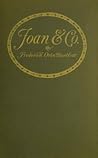
 Joan & Co. by Frederick Orin Bartlett
My rating: 5 of 5 stars
Pig-in-a-poke book, picked up from the Project Gutenberg feed without knowing anything about it, or the author, not even the genre. It turned out to be a good find.
It's a romance, of sorts, but it's more than that; there's a theme, too. It's a very character-driven book, so let's start with the characters.
Mr Burnett has built up his business (manufacturing patent leather) over 30 years, and is doing well. He would love to hand it over to his son Dickie, recently graduated from college, but Dickie isn't very interested in the business. In fact, the only thing Dickie is interested in is Joan, the beautiful daughter of a wealthy family (wealthier than the Burnetts, though not so much so that they're in different social strata). Joan has also recently graduated, but unlike Dickie, she is discontented with the shallow and narrow life of her social circle and wants to do something that matters.
Her eyes have been opened to this shallowness and narrowness by befriending Mildred, a woman who had scrimped and saved and come out from Montana to attend college (the same one as Joan) and better herself - only to starve and work herself to death. Through Mildred, Joan briefly met Devons, Mildred's cousin, who comes from a similar hardscrabble background (his father's a small farmer), and has managed to get educated and come up with a revolutionary new process to produce patent leather. But nobody will stake him to compete with the Burnetts, and the vice-president of Burnett's, a scheming fellow named Forsythe, offers him a pittance to buy it outright, and no other deal.
Devons has run out of money to live on, and goes out in bad weather, undernourished, to ask an old friend for a job, but is fortunate enough to be run down by Joan's car before he dies of exposure. Recognising him as Mildred's cousin, she takes him home and ensures he's nursed back to health, getting to know him in the process. She wants to invest in his process so he can start his business, but has no money she controls of her own. However, Dickie, whose proposal she recently turned down, said that regardless, she could always ask anything of him, and what she asks is for him to fund the business.
With his usual lack of interest in anything other than Joan, Dickie makes no inquiries as to what the business is, and Joan is unaware of where Dickie's family get their money (it's apparently not something you talk about in their circles). She also doesn't mention Dickie's surname to Devons. So Dickie is funding not only his rival in love (because Devons has fallen for Joan too), but, unbeknown to any of them, his father's rival in business.
There's a certain amount of coincidence involved in setting this up, of course, but I didn't mind it, because it was in the interests of causing conflict, not resolving it, or removing character agency.
Complications, of course, ensue, not least because of the scheming of Forsythe, which ends up blowing up in his face. Along the way, the author contrasts two kinds of people: those who have too little money and must struggle to get ahead, sacrificing their health and wellbeing to do so, and those who have too much obtained too easily, who live a pointless existence with nothing to strive for. The two generations of the Burnetts represent the two situations, but so do Devons and Joan, in a different way. Joan, at least, is trying to involve herself, to do something that matters to someone, even if - raised to be unworldly and naive - she doesn't know how to go about it.
Both of the young men try to put Joan on a pedestal as a princess and do everything for her, but she doesn't want that; she wants to serve, to do something that matters, even if only to one person. The gendered work assumptions of the time do come in here, but not so blatantly that they became a big problem for me. Joan has been deliberately raised to be ornamental rather than useful, and her rebellion against this is consequently somewhat ineffectual, but at least she does rebel.
There is a happy ending in which everyone gets at least a form of what they wanted (except for Forsythe, who's the designated villain), but the form of what they wanted is generally not what they thought they wanted, and not what I was expecting. This is a good thing.
Because it's not formulaic, and because it does have, and competently develop, a thought-provoking and well-thought-through theme, and because it's well edited and in general soundly written without being overwritten, it gets five stars from me. It's a buried gem from more than 100 years ago, and I'm glad I uncovered it and took a chance on it.
View all my reviews


No comments:
Post a Comment