Monday, 7 October 2013

Review: The Republic of Thieves


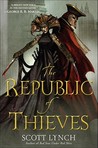
The Republic of Thieves
The Republic of Thieves by Scott Lynch

My rating: 5 of 5 stars


This is a book I (and many others) have been waiting for literally for years. The author had some tough personal times, involving severe depression, and the series was put on hold as a result. Now it's back, though, and when I saw on Netgalley that I could get a pre-publication copy for review, I jumped on it.

Why do I like this series so much? On the face of it, it's not my kind of thing. The characters are lawbreakers in a cruel and unjust sword-and-sorcery world, foul-mouthed, and continuously abused by their author. It's like someone took Fafhrd and the Grey Mouser and turned everything up to 11 (and I'm not a big fan of those books at all).

I think it's partly because Locke Lamora, the protagonist, is so hapless I can't help being on his side. It's partly because I do love a trickster story, and Lamora is a classic trickster, not only in his cleverness but also in the way his cleverness often ends up getting him into horrible, horrible trouble, and then out again, and then in again, and then out again...

It's partly, too, because it's just so very well written. Smooth, well-paced, not a wasted incident over the whole long book. Everything connects to something else. In this book, two stories are interweaved in two different time periods with some of the same characters, and they throw light on each other in a way that's wonderful to watch.

Because it's been so long since the last book, I can't remember for sure if the previous two books also do that. In fact, I can't remember the previous two books particularly well at all, in terms of actual incidents. This was a slight drawback, since this book keeps making callbacks to those earlier incidents and I didn't remember what they were talking about, but I still enjoyed it as almost a standalone. It would be worth re-reading the previous books immediately before this one, though.

You can tell a book by an author who's suffered, and knowing that Lynch has struggled with depression adds extra emotional resonance to some of the early scenes in which Locke's friend upbraids him for wanting to give up and die. The characters have powerful emotions, great hopes and great triumphs and great disappointments, without ever seeming theatrical or over-dramatic.

One minor negative for me was the worldbuilding, or comparative lack thereof. It's a fairly typical sword-and-sorcery setting, feeling late-medieval/early-renaissance (though without guns), with Italian-style city-states that remember the fallen Empire. There are important cultural differences between the city-states (at least, they're important to the inhabitants), and there are a few cultural referents that are made up, but a lot of the world, the culture and the language is just taken whole-cloth or minimally altered from our own world, including expressions like "you could hear a pin drop". I'm not going to call that lazy worldbuilding (nothing about this book is lazy); it's a particular approach, which trades requiring a bit of extra suspension of disbelief from those like me who notice such things against not letting a lot of unfamiliarity in the worldbuilding distract most readers from the story being told.

Overall verdict: this was worth the wait, and I hope the next one is well underway.


View all my reviews

Tuesday, 1 October 2013

Review: The Whirlwind in the Thorn Tree


The Whirlwind in the Thorn Tree
The Whirlwind in the Thorn Tree by S.A. Hunt

My rating: 4 of 5 stars


Let's start with the disclaimers. I know the author on Google+, which is why I read the book. I'd picked it up on a free promotion, and when I realised I didn't have the up-to-date version, he kindly sent me his latest build. We've corresponded about some questions I had (which he cleared up, so they won't appear in this review), and I'll be sending him some more notes too. Based on his response to me so far, many of the issues I identify may well be fixed soon, so there may be things I mention below that are no longer problems in the later version that you buy (because I hope you do buy it).

I actually started reading this book twice. The first time, I got through the part where the protagonist/narrator gets back from deployment in Afghanistan, and his wife has left him, and then the phone rings and his mother tells him his father's died... and I stopped, because I thought it was going to be too dark and tragic for my taste.

Then I kept reading Sam's posts on G+, and realised that he's a very accomplished writer, and decided that I did want to read it after all. And, in fact, after that second shoe drops, apart from the scene where people are being dragged down to be consumed by an evil god it's mostly not that distressing, despite the "dark fantasy" label.

When I say "very accomplished writer", I mean that he has a feel and a skill for language that's unusual in the indie writers I read. His prose is not without flaws, though. He's over-fond of the semicolon, his imagery can shade towards the purple and, sometimes, the incoherent, and he does the Steven Donaldson thing of dropping vocabulary words every few pages, which, taken all together, comes across to me as maybe trying too hard.

Unfortunately, too, the words don't always mean what he seems to think they mean, and occasionally mean the opposite. He describes two characters as having "reedy" voices, for example. From context, he means big, booming voices, but "reedy" means thin and weak. "Sojourn" is twice used to mean "journey", but it means staying in one place (that's a common error).

Then there are the florid descriptions which leave me unable to imagine what's being described, like "a black frock coat swarthy with curly pinstriping". If it's black, it's already swarthy, and what on earth would "curly pinstriping" look like?

Very few people have the vocabulary to pull this kind of writing off, and even those who do, I think probably shouldn't attempt it. I know it's a classic way of writing fantasy, but I find it distancing even when done well, and annoying when done badly. Here, it's not done terribly, but it could be done better. It's possible (though difficult) to write lucid, straightforward prose that's also beautiful and evocative. Emma Bull does it, Ursula Le Guin does it, and I wish more genre writers did.

When we come to characters, there's some good news. The protagonist/narrator is based on the author, but he is definitely not Gary Stu. He's in poor physical and emotional shape, he gets scared, he freaks out. Things don't fall into his lap; he struggles, he suffers. He makes meaningful decisions, he's loyal to his friends. I'm happy with him as a character.

The secondary characters are not as clearly drawn. In particular, the minor characters in the other world I found difficult to separate in some cases, or remember who was who, perhaps because a lot of them are introduced in a short span of time. I'm sure they'll gain depth in the second book.

The premise is interesting. The main character's father is a well-known fantasy author, and it turns out that he wasn't making up his other world; he'd lived there, and was more a biographer than a novelist. The protagonist goes to the other world and becomes involved in defending it, and by extension our world, from other-dimensional villains.

It's a good premise. Portal fantasy is out of fashion, for some odd reason, but I've always liked it, and of course the fictional-worlds-are-real trope is a popular one (see Jasper Fforde for perhaps the best-known of many examples). I think the author does it justice, though with a couple of reservations which I'll mention next. He also does a nice job of including quotations from the father's books, which are in a subtly different style, though I didn't always see the relevance of them to the chapters they preceded.

I wasn't that happy with the worldbuilding. The narrator says that "there are very few analogs between Earth and Destin when it comes to culture", but there totally are. Destin is basically a mashup of classic swords-and-sorcery fantasy with the Old West, and the two elements don't blend well. Shields and sixguns. Characters who wear doublets and jeans. Yes, those are actual examples. It didn't work that well for me, technologically or historically. Or linguistically; I have a degree in English language, so I know how contingent and random the development of the English language was, and having another world in which people speak a version of it is unlikely on the face of it (though I'm willing to give it the Trope Pass, reluctantly, so that we don't have to struggle with language learning and translation to the detriment of the story).

The big, all-too-common worldbuilding gaffe, though, is this. One of the characters, an Earth person who's familiar with the other world from reading the books, says at one point, "There's no Christ. No Bible. Why would there be a Christmas?" And then roughly a thousand words later there's a minor character called Joshua. I understand why authors don't want the Christian religion in their books, but if you're going to take it out, take it all out. (The thing is, it's so entwined in our culture, to a degree that most people are unconscious of, that unless you base your books on a non-Western culture, you can't take it all out. This is an enduring problem of fantasy worldbuilding.)

Anyway, so much for the world. What about the plot? This is the first of an epic fantasy series, and as is often the case with such series, it's not a complete story in itself but an introduction to the world and the characters and the situation. That's not to say that nothing happens, by any means, but there's more a sense of beginning at the end than there is a sense of ending, if that makes any sense. Thinking back on my experience of reading it, I remember more explanation and exploration than I do action, though there are certainly several well-written action sequences, spaced well throughout.

One of the important questions to ask, when talking about plot, is "What do the characters want? Do they strive for it?" What the characters want is reasonably clear. The main character, Ross, wants to investigate the mystery, possibly avenge his father's death, and rescue and defend his friends. His friends want to visit the world of the books they loved growing up - and this weaker motivation leaves them as weaker, less interesting characters in this book, though they'll no doubt strengthen in future books thanks to the revelations towards the end of this one. Stakes are both cosmic and personal, which is a strong combination, and shows promise for the series.

Overall, this is definitely an above-average first novel, though for me it has some (non-fatal) issues. With more discipline applied to the language, and better integration of the different elements of the worldbuilding, I can see this becoming a classic series in the future.


View all my reviews
Saturday, 28 September 2013

Review: Torrent


Torrent
Torrent by Lindsay Buroker

My rating: 5 of 5 stars


An excellent beginning to a new series from one of my favourite authors.

I enjoy nerdy, awkward characters, and we have an abundance of them here. The skinny Star Trek fan, the would-be Indiana Jones (complete with bullwhip, which turns out to be surprisingly useful), even the tennis star, sidelined by injury, whose awkwardness comes from having focussed so much on her sport that she doesn't know much about anything else. They're young, they're enthusiastic, they're curious to the point of incautious (more or less the Scooby Gang, complete with vanagon, though without any Great Danes), they're short of money, and when the chips are down they're determined and courageous. At least, the narrator, Delia, is. The other two are maybe a little less so, though they show potential.

As a big fan of the author's Emperor's Edge series, I couldn't help noticing similarities. Delia and Amaranthe (the protagonist of EE) both have emergent leadership qualities. The seeming magic in both series is mixed up with seeming aliens (it's not yet clear in this series whether it's really magic or they're really aliens, or both). There are hard-to-kill monsters and underwater caverns.

What's different is that this story is set in our contemporary world and told in first person. It's (broadly speaking) urban fantasy, rather than secondary-world steampunk fantasy. That's one of my personal favourite genres to read, more so than steampunk, if anything, and I thoroughly enjoyed this.

There were a few minor editing issues, but it's an improvement on the EE books in that respect, as well.

Lindsay Buroker is an experienced series author, and she does a good job of setting up some things to be resolved later (to keep us interested in reading the series), while also giving us a complete story with a resolution. She ties the characters together well, gives them clear, strong motivations and distinct personalities, and rubs those personalities together entertainingly.

I'm very much looking forward to more in this series.


View all my reviews

Saturday, 21 September 2013

Review: Constellation Games


Constellation Games
Constellation Games by Leonard Richardson

My rating: 5 of 5 stars


This is a book that's brilliant enough that I don't always get it, whether because I miss some of the references or because I'm just not thinking at the level of the author. It's the kind of book I want to read again sometime to see what else I can get out of it.

It's true speculative fiction. What I mean by that is that it isn't just another genre sausage, with the same basic shape and contents as all the other sausages in that genre; it actually has a new angle. This is first contact as seen through the eyes of a video game developer and reviewer who attempts to understand the aliens by playing their games.

The Constellation, the peaceful alien civilisation that contacts Earth in 2012, is a post-scarcity anarchy (fans of Cory Doctorow and Charles Stross will know what that is, and probably enjoy this book a lot). They're pleased to discover that Earth is not another of the planets where a civilisation has destroyed itself, leaving only fossils, since this sad fate is more common than the survival scenario. They'd like to keep it that way, but humans are irrational and get upset when the aliens try to help with things like global climate change.

The story is told largely via a series of documents, mostly blog posts, but there are also IM conversations and a few other formats. Some of the short chapters, though, are headed "Real Life" and a date, and since they're written in almost the same style as the blog posts, I did often find myself checking back at the beginning of the chapter I'd just finished to see if it was a blog post (and hence public, or at least circulated to the narrator's friends) or not. That's important, since as the story goes on, the blog posts contain more and more lies for various reasons. Mostly, these have to do with the narrator protecting himself or someone else.

The language has some wonderful moments. Not only the slightly distorted English of the aliens, but some of the narrator's phrases. "He twisted some vowels into balloon animals," for example, as a description of an alien speaking an historical language of his race. (The several alien races, by the way, are referred to by various words that different human groups use to mean "alien"; besides the Aliens, there are Auslanders, Gaijin, Farang....) There are also some lovely moments of commentary on our society. "As if we'd all gotten together and agreed to do whatever it said on signs," the narrator observes when a minor official glares at him for not doing something posted on a sign. There's a strong thread of anti-authoritarianism, if you hadn't already picked that up (also, as one of the aliens observes, the narrator swears a lot).

The references to technology and video games are a mixture of real-life and invented. There's a character called Dana Light who is more or less a Lana Croft, for example, but not exactly. That's helpful for someone like me, who hasn't played a great many video games, because if a lot of the point depended on intricate knowledge of the trivia of popular culture (as in, for example, Ready Player One), I would have enjoyed it a lot less than I did. Instead, it's about the phenomenon of gaming and how it expresses and shapes culture and psychology, and using that as a lens to examine things about culture and psychology.

The editing could have been better. The book deserved for it to be better, in fact. Based on this and on another book I've read from Candlemark & Gleam, the small press that published it, what you get from C&G is developmental editing on your high-concept book, rather than meticulous proofreading and copyediting. What the customer gets is probably pretty much what comes out of the author's word processor. In the case of the other book, that included a lot of homonym errors. In the case of this one, it means a number of what are basically typesetting mistakes (missed words, misspellings, lost quotation marks, one instance of an inconsistent time in a sequence of tweets), plus a few apostrophes missing in phrases like "Ten mortgages worth of signatures" or misplaced in words like "childrens'". It's a long way from terrible, but I wish it had that extra polish.

Between the less-than-flawless proofreading and the slight unlikeliness of some of the aliens, this isn't a perfect book, but it is an excellent one, funny, thought-provoking, original and possessing a rare depth, and that is why I've given it five stars.


View all my reviews

Tuesday, 17 September 2013

Review: Salamander


Salamander
Salamander by David D. Friedman

My rating: 3 of 5 stars


A brilliant young woman works with her mentor, a clever but unworldly theoritician of magic, to foil dynastic plots and ensure that a powerful new way of doing magic doesn't fall into the wrong hands.

Overall, I enjoyed this. I'm a fan of the growing "magic school" subgenre, I like clever protagonists, and the writing was reasonably competent.

I say "reasonably" competent because, while the author mostly knows where to put his commas, he occasionally gets apostrophes wrong with plural nouns ("magister's wing" when there's more than one magister, for example). He's also sloppy with his quotation marks. These are minor issues, though, given that I didn't notice any homonym errors, the bane of indie (and, increasingly, traditionally-published) books.

What I didn't like was the infodumping of theory of magic, literally in the form of lectures (both from faculty at the magic school and also from the clever young woman to her friends at lunchtime). Infodumps are dull at the best of times, and this particular author uses a dry dialogue style without contractions - which also leaves most of his characters sounding the same. Also, the first three chapters consist largely of these infodumps (at least, that's how it felt), and there were one or two more later in the book.

It's true that much of the content was relevant to the resolution of the plot later on, but there are better ways of presenting this background information than in big lecturing chunks.

I mentioned that the characters mostly sound similar (though one of them, a farmer's son, does drop words out of his sentences, which makes him distinctive). At least one of them, Edwin, also turns up without introduction or description and never seems to do much. The remainder, though, are distinct in their personalities and I found it easy to keep them straight in my head.

I picked this book up because the author talked about it in a comment on someone else's blog and it sounded interesting (yes, that does occasionally work, authors). It was good enough that I'd read another in what I assume will be a series, though I'm really hoping for less infodumping next time.


View all my reviews

Friday, 13 September 2013

Review: The Pyrite War


The Pyrite War
The Pyrite War by Blake M. Petit

My rating: 4 of 5 stars


Let me start out by saying that I'm a fan of Siegel City and its superheroes, having loved [b:Other People's Heroes|1792929|Other People's Heroes|Blake M. Petit|http://d202m5krfqbpi5.cloudfront.net/books/1333327221s/1792929.jpg|1791912], and I remain a fan after reading this book.

Let me continue by saying that it has definite flaws.

Firstly, the editing. Most of the errors I spotted (which I'll pass on, as I usually do, to the author so he can correct them if he wishes) were typos. Now, everyone makes typos, but there were a great many of them, about one per thousand words by my rough calculation. And then there were the errors which I wouldn't expect an author who's a former newspaper editor and a current English teacher to make: the excess apostrophe in the phrase "first things first" and a couple of other apostrophe errors; "diffuse" instead of "defuse", "crevasses" for "crevices" and "pouring over information" instead of "poring"; "may" used in past tense narration instead of "might"; a dangling participle. Characters' names are spelled inconsistently, as well, which is a surprisingly common mistake.

To me, one of the things that separates professional from amateur writing is whether the writer knows and consistently applies this rule: if someone is addressed by name or title in dialogue, there should be a comma before the term of address if it isn't at the beginning, and after the term of address if it isn't at the end. But we get "Mr. Ruston it's not like that" and similar breathless sentences. That's an error that never fails to jerk me out of the story and leave me shaking my head and sighing, the more so in this case, since the author should know better.

The book is set in 1939, but to me it lacks a sense of that time. It makes frequent reference to the looming threat of World War II, and mentions the Wizard of Oz movie (released 1938), but it's in the small details that it doesn't ring true: names, slang, social differences. A teenage boy describes himself as "freaked out" (an expression first used in the 1960s), and the narrator uses "warm fuzzy" (1970s). A socket on a radio is called a "port". There's a reference to military body armour, which, while it did exist at the time, was too bulky to be practical and wasn't used in the field. A young female superhero wears a "cheerleader-style skirt" of a type not used in cheerleading until the 1970s. Five minutes after people stare at a black couple emerging from a car with white people, they are sitting "shoulder to shoulder" at a soda fountain and nobody bats an eye. There are characters called Samantha and Jason, both common names now, but rare before the 1960s. Again, individually minor errors, but collectively they destroyed the sense of authenticity of the time period for me. None of this is hard to check, either, with Google search, Ngram Viewer (which shows when phrases began to be used), and behindthename.com. You just have to be aware enough to think of checking it.

One more category of complaint, story flaws, and then I'll start praising it. There's a continous sequence in which we somehow go from "people have just arrived" to "they've been here three days" with no transition (during which the narration briefly drops into third person from the first person that it uses everywhere else).

That's just inattentive rewriting. What's more serious, and harder to fix, is that a couple of times there's something in the story that to me is clearly there for plot purposes, and not because it makes any sense whatsoever. The first one is that the mad scientist can't miniaturize radio transmitters, but can miniaturize a recording device (so that the device can be destroyed and the heroes are left with no evidence, although since the villain didn't actually say anything clearly incriminating I don't see what difference it makes). Given both the real technology of the time and the technology that the same scientist has already used at that point of the story, this is pretty much nonsense.

The other flaw, the biggest in my mind, is near the end, where a group of the heroes does something that anyone can see is completely idiotic, with tissue-thin justification, apparently solely in order to allow the tension to be ramped up. Of that, I am not a fan.

What I am a fan of is how Petit plays with superhero tropes, without ever going too over-the-top in the winks and hat-tips. The premise is "What if Superman was not just a dick, but actually a homicidal lunatic pretending to be a hero?" The powers of the supers are a combination of nods to the classics and fresh ideas (as in Other People's Heroes). The actual story, apart from a couple of stumbles which I noted above, is well-paced, well-plotted and satisfying. The author does a fine job of making the stakes both important to the world at large and personal to the narrator, and I enjoyed the narrator's voice and the voices of several other characters (though I'll admit that a couple of the minor characters blurred together for me, and I had a hard time remembering which was which).

Because of those strengths, and because there aren't enough good supers books, I'm giving this four stars despite its flaws. Consider it three and a half rounded up.


View all my reviews

Wednesday, 11 September 2013

Review: Gooseberry Bluff Community College of Magic: The Thirteenth Rib


Gooseberry Bluff Community College of Magic: The Thirteenth Rib
Gooseberry Bluff Community College of Magic: The Thirteenth Rib by David J. Schwartz

My rating: 4 of 5 stars


First, let me say: this is one of the best-edited books I have read for some time, and that was why I bought it, despite some warnings in the reviews I read about a non-conclusive ending. I thought I could at least enjoy the ride to that ending, and I was right. I spotted four extremely minor errors, two of them typos and two of them usage issues, which is excellent.

However, the ending itself didn't disappoint me either. Certainly, not everything is resolved, but to me, that's good news; it implies sequels, and I want to read more in this setting.

The book has been described as "Harry Potter meets X-Files", which is almost completely inaccurate. Yes, it involves a college of magic and a federal agent investigating the uncanny, but that's the extent of the resemblance to either of those franchises. The college is mostly a backdrop, and mostly (apart from the fact that magic is taught there) a standard American college. The agent is not a student there, but a teacher. She's nothing like Mulder or Scully, and her case doesn't have an X-Files vibe either, to me at least.

So that's what it isn't. What is it?

It's a well-written urban fantasy/alternative history, in a world where Aleister Crowley cleaned up his act, had real magic, and deployed demons against the Japanese and Germans to end World War II. It's set in the present day, and the main character is a federal agent in magical law enforcement. Her own magical skills are not great, but she can read auras, which mostly makes up for her neurological inability to recognise faces.

Yes, the protagonist is disabled. She's also black and a woman. Several other characters are bisexual or gay, and one is genderqueer. If all of that bothers you for some reason, don't read it, but personally I didn't notice any of the soapboxing that one reviewer on Amazon complained about.

Seanan McGuire had a great answer to a reader who complained "Why did you make X character gay when it made no difference to the story?" Her reply was to the effect that she didn't "make" him gay, he was gay, and it didn't have to be significant to the story any more than someone being straight. There are gay people. They're people. You'll meet them at some point, and they have all the characteristics of other people. Their sexual orientation is just one thing about them, and if they're characters in a story, that doesn't have to be what the story is about.

If this book had a weakness, for me, it was that the magic system didn't come across as having been completely worked out (so there's another parallel to Harry Potter, then). It was used more or less as a convenience. The magic theory lectures didn't seem to translate into plot points. Sometimes magic just replaced technology, like the crystals which were cellphones (though at one point the author apparently slips and mentions a telephone). Sometimes it did things that the plot needed. It didn't, to me, give the impression of having been planned out in advance, in detail, with all the implications for how it would change society taken into consideration. That's extremely hard to do, by the way, and it's not like magic was used as a deus ex machina on every page. It caused as many problems as it solved, too, so points for that.

When I was looking at the author's other books, I saw that he's done a supers book which I looked at a while back and didn't get because the sample didn't quite hook me. I think I might take another look at it, having read this one, because overall I'm impressed.


View all my reviews