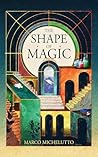
 The Shape of Magic by Marco Michelutto
My rating: 4 of 5 stars
A magical university story, but not "dark academia" (at least, as I understand it).
The world feels rich, and the magic system has had some thought put into it, which is not always the case with current fantasy. The ancient university feels centuries old, probably because the author is from Europe, where things often are centuries old.
The premise involves three friends: a woman who's a King's Ward, randomly selected from the population to serve the kingdom and provided with an education in order to do so; the eldest son of a duke, who's semi-defied his father in order to learn magic; and a third, who doesn't have much to distinguish him apart from being studious (I kept getting him confused with the duke's son). They have discovered coded instructions in what purport to be old novels for how to use teleportation glyphs to get into hidden rooms in the university, and have found some interesting stuff.
The dowager queen, who is largely in charge, since her son is young, has come to the university talking about a threat of invasion from a neighbouring country that has got rid of its royalty in a revolution and become a republic. She's using this as a reason to convert the university from being almost entirely dedicated to theoretical research over to producing graduates who can project practical power on her behalf, and is also searching for three legendary artefacts that will give her even more power - according to her, to defend the kingdom. But the trio have their doubts.
As I expected going in, given that English isn't the author's first language, the English is often not idiomatic. An editor is credited (possibly not a copy editor), and multiple beta readers, but none of these seem to have picked up the many fumbled idioms where words have the wrong number or the wrong preposition is used; the frequent absence of the past perfect tense when referring to an event before the narrative moment; the use of "may" instead of "might" in the past tense (if it could be "could," it should be "might"); an overall shortage of grammatical commas; occasional incorrect dialog punctuation; or even some basics like almost always omitting a comma before a term of address (the "let's eat Grandma" error), not capitalising a title when it's part of a name, or not starting a sentence with a capital. To be fair to the editor, if the manuscript had a lot of errors they would inevitably miss some, but some of those are glaring. On the other hand, I've also seen as bad or worse from native English speakers. I had a pre-publication copy via Netgalley, and there may be more editing done before publication, but there are just so many issues I don't think it could be cleaned up enough in the time. Of course, if all those people missed them, there will be plenty of others who don't notice or care, but I did, and it degraded the reading experience for me.
The other issue with the writing is that the style will cruise along in semi-formal "fantasy prose" mode for a while, and then a clanging contemporary colloquialism will get dropped into the middle of it. It needs to pick one or the other.
On the positive side, it's a good story competently told, the characters are appealing, the world feels more developed than is often the case, and the tone is cozy and noblebright.
View all my reviews


No comments:
Post a Comment