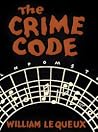
 The Crime Code
 by
William Le Queux
My rating:
3 of 5 stars
I read this author's first novel,
Guilty Bonds
, and found it absurd and inept. I said in part in my review: "It's melodramatic. It's implausible. It's rife with coincidence. It's heavily dependent on bad decisions by the main character. And the final explanation doesn't stack up."
Still, a lot of people who write bad first novels improve as they get more practice. How was he doing more than 35 years and roughly 150 books later (he wrote a lot of books, very quickly)?
Well, this novel is melodramatic. It's implausible. It's rife with coincidence. It's heavily dependent on bad decisions by the main character. And the final resolution is remarkably similar to the one in
Guilty Bonds that didn't stack up.
I think this is my last Le Queux.
Some spoilers follow in this plot summary; without them, you wouldn't be able to tell how ridiculous it is.
Hipwell, the protagonist (if you can call him that; he's more reactive than proactive, and often more passive than active) goes to the defence of a woman who's being mistreated by a man late at night in London, on his way back from a gambling house. In the subsequent scuffle, the man draws a pistol, which goes off, killing him. The woman then shows her ingratitude by accusing Hipwell of murdering him and saying she'll set the police on him, so, to avoid scandal (his father is a prominent MP, and he also has political ambitions), he flees the scene and goes into hiding, disguised as a working-class journalist. As you do.
He happens to take lodgings in the same house as someone who later turns out, by complete coincidence, to be in the same gang of jewel thieves as the two people he encountered earlier, and what's more, making his way home through one of London's legendary fogs, he accidentally goes into the wrong house and finds the gang, including his fellow lodger, dividing up the spoils. They think he's a police spy, and, desperate, he tells them the truth, that he's hiding from the police, and why. But the woman he quixotically rescued turns up later too, and explicitly states that he was not the man who killed her lover. His fellow lodger, a young woman, says, "Let's blind him so he can't testify to our identity" (how would that even work, given that he can describe them and knows where she lives, and they've mentioned someone's first name and that he's a medical student at Guy's Hospital?) But what she actually does is inject him with a drug that makes him compliant to them and "not himself," until two years later he accidentally hits his head and snaps out of it, but can't remember those two years. Meanwhile, it later emerges, he has learned to be a jewel thief and is good at it; he has also been appointed to the responsible post of King's Messenger, or diplomatic courier, which conveniently means that his bags won't be searched during his many travels around Europe with dispatches. The gang makes no use of this as far as is ever mentioned.
Sometime during his time of "unconsciousness" he has married one of the gang, for reasons never explained, despite being in love with and engaged to a lovely girl who's the daughter of a prominent lawyer. When his wife eventually turns up, she explains a lot of stuff to him that he should already know and shows him the code of the title, which is based on musical notation.
Around this time his fiancee is abducted and disappears.
He goes to the head of the gang (taking with him a stolen necklace in his diplomatic baggage) to plead to be released from his service to the gang on his word of honour that he won't tell, honest he won't. The chief refuses, and gives him a message in the musical code for his wife, who's setting out to harm him; Hipwell has the key and could decode it, but doesn't, even though for all he knows it says "Rosenkrantz and Guildenstern this idiot." He also doesn't use the code to warn his wife about a police raid, even though he's afraid she'll shop him if she's arrested. This is what I mean about him being passive and making obviously bad decisions.
The raid indirectly leads to his fiancee being recovered, and then (as was obviously going to happen) his wife conveniently dies, freeing him to marry again; he tells his prospective father-in-law the whole story, and of course is advised that it's fine, he wasn't responsible for his actions (obviously apart from smuggling the necklace that he knew to be stolen, though that isn't mentioned), no consequences need ensue. He begs the chief of the gang to be released again, and this time it's granted, following which the chief also conveniently dies - but not before restoring the necklace to its owner. The help given to Hipwell earlier, the release, and the return of the necklace are all thoroughly out of character for this ruthless individual, who's never called an anarchist but probably is one, as was the case with the plotters in the author's first novel. He's Russian, but steals from the Soviet authorities, committing several murders without hesitation in the process.
It's basically a very similar story to the first book, with all the same flaws, except the author has apparently learned not to dangle his modifiers or miss out the past perfect tense somewhere in there. He does still hyphenate things he shouldn't and put a good many commas in the wrong places, though.
I should probably give it two stars, but I did enjoy some of the action bits towards the end enough that it just barely squeaks three. Still, Hipwell is too stupid to live.
View all my reviews
 The Wizard Who Kept Himself Suspicious by Scott Lynch


![Mr. Mendlebee's Pandimensional Literary Repository [and Yarn]](https://i.gr-assets.com/images/S/compressed.photo.goodreads.com/books/1774667355l/244714087._SX98_.jpg)