Monday, 13 June 2016

Review: The Facefaker's Game

The Facefaker's Game The Facefaker's Game by Chandler Birch
My rating: 5 of 5 stars

My usual rule of thumb is that any sentence in a blurb that says "for fans of $author" is most likely a bold lie by the marketing department. I decided to risk it, though, since I am indeed a huge fan of Scott Lynch and Patrick Rothfuss, primarily for their likeable rogues in grim settings; and this time I wasn't disappointed, because that's exactly what I got.

I wasn't disappointed in the least - though, rereading the blurb, it also describes the book as "picaresque," and technically it isn't, since it lacks the essential "episodic adventures" element. I'm always happy with a heist, though, and although the heist doesn't end up being the central focus, there's plenty of heist-like scheming along the way.

There's also a wonderfully dark, grimy setting, with mysteries that, in this first book at least, are never resolved. Why do "rasas" turn up on the street with no memory, and where do they come from? Where do the animalistic people who roam the slums at night come from (and where do they go during the day)? We don't know - and we don't need to know. These are just among the realities the protagonist has to deal with, along with a cruel thief-lord and how to take vengeance on him, the difficulty of trusting his fellow rogues, his struggle to learn magic, the problem of keeping his friend safe, and periodic physical dangers as he attempts to solve his other problems.

The protagonist is well developed. A "rasa" who doesn't remember his origins, he has an instinct of compassion and protection towards others who are weaker, and rebellion towards those who are stronger. (This means that, although the setting is indeed grim and dark, the book itself is not grimdark, much to my relief.) He's one of those magically talented youngsters who show up so often in fantasy, but he struggles and works hard to learn magic, and has to have a moment of personal growth, not just desperate circumstances, to make a breakthrough. He's believably untrusting of his benefactors, and all of his actions are credibly driven by internal and external conflicts, even the ill-advised ones.

The magic system is well thought out and essential to the plot. Although there is a minor bit of coincidence here and there to get the characters together (and to provide a magical tool, which isn't too essential in the long run), it didn't strain my disbelief.

Apart from a few very minor typos in the pre-publication version I received from Netgalley for review, it's cleanly written and generally extremely competent, especially for a first novel by a relatively young author.

Above all, though, it's a gripping adventure with a character I wanted to see succeed, and who I want to read more about. I'm very glad that the ending points to a sequel, and I hope it's as strong as the first.

View all my reviews

Wednesday, 8 June 2016

Review: Pisces of Fate

Pisces of Fate Pisces of Fate by Paul Mannering
My rating: 4 of 5 stars

I enjoyed the first in this series, despite the silly names, so I looked forward to reading this one. There's plenty of good stuff in it - comedy, adventure, a little bit of musing about what makes life worthwhile - but ultimately I felt it muffed the ending and didn't quite live up to its promise.

Partly, I think, this is because the protagonist, Ascott Pudding, is one of those directionless losers that you get sometimes as the protagonists of comic fantasy (Tom Holt comes to mind, and Terry Pratchett's Rincewind), and that means that he never really settles on a clear goal. Is he trying to complete his book on sea life? Well, sort of, but when (view spoiler) it doesn't upset him for very long, and he abandons that life work (which was really a way of not facing his issues anyway). Is he setting out to build a romantic relationship with the competent Shoal Smith? Well, a bit, but he's so pusillanimous about it (and she, understandably, is so lacking in keenness on the idea) that it never really goes anywhere, just serves as a source of tension and embarrassment. Is he trying to save his friend the parrot? Definitely, and he risks his life to do so - a decision that I felt wasn't adequately motivated, and somewhat out of character for someone so lacking in physical courage or ability. But that (authentically exciting) moment is soon over, and there's still plenty of book to go.

So is he trying to find the pirate treasure? He is, using the nonsensical argument that the villains will pursue him and Shoal as long as they think they're hiding something, so the obvious thing to do is find the treasure first and... hide it. But when (view spoiler). He's also, a bit, trying to find a way to save his sister Charlotte, even though they're not close; trying to figure out what is going on with all the gods, including the one who keeps dropping in at odd moments, occasionally as if out of a machine; and pursuing various minor, scene-level goals, such as not being killed by a highly intelligent octopus(view spoiler). But none of these goals (except the octopus one, briefly) drive him very strongly. Overall, he just isn't a very focussed or effective character, and I think that was the book's ultimate weakness. There are plenty of good elements - pirate treasure, the intelligent octopus, an intelligent parrot, apparently intelligent cats (who don't end up being important to the plot), a race across the backs of whales, a mystery, the meaning of life. For me, though, they didn't completely gel together into a fully successful book at the end.

Another round of copy editing also wouldn't go amiss; nothing major, but a number of "let's eat Grandma" errors (missing commas before terms of address), and a few other bits of slightly misplaced punctuation, including the dreaded interrobang. At one point, the text talks about a "brace of hairy fellas" and then, in the next sentence, about "some of" these fellas; a "brace" means two. There's also the occasional typo, about the usual number.

Overall, I'm still giving it four stars, because there was plenty of good material and I did enjoy it. I just thought it had some room to be a better book than it ultimately was.

View all my reviews

Monday, 6 June 2016

Review: Vigil

Vigil Vigil by Angela Slatter
My rating: 5 of 5 stars

This book had the potential to end up as just another cookie-cutter urban fantasy, with a kickass heroine of mixed human and magical descent in the noir PI role, getting beaten up by monsters and eventually making the city safe for the innocent again. Fortunately, the author is skilled enough to lift this classic formula to a new level, not just executing it flawlessly but adding a layer of depth that the thousands of UF clones out there seldom achieve.

Primarily, I think, she achieves this by making the characters' relationships rich, varied, powerful, and fundamental to the plot. The protagonist's mother was missing from her life, and her father got arrested for the (literal) monster he was when she was still very young; she was raised by her grandparents. So far, nothing we haven't seen before. But then we get the solo mother next door and her daughter, who's a kind of niece to the protagonist, and whose actual aunt is toxic and crazy, and then we meet people who have dysfunctional families, who have happy families, who are alienated from their families, who have no families but have people they love who aren't genetic relatives... Family, in all its many forms and manifestations, ties the whole story together and drives the plot, along with a theme of caring for and protecting the young, and what happens when you don't.

I did feel that the protagonist's own romantic relationship was underdeveloped, as was her love interest; he ended up, for me, being a genderflipped damsel in distress (though the protagonist, to the author's credit, is not just an example of the Man With Boobs trope; far from it). I noticed in the afterword that he shares a name with the author's husband, so perhaps she has fallen into the trap of introducing someone she knows into her book and, therefore, not making them sufficiently real to the reader, who doesn't know them and can't fill in all the details for themselves.

That's a minor flaw, though, more than made up for by the book's many virtues. For example, it has a strong sense of place, as urban fantasy should. It's set in Brisbane, where I lived for most of a year (albeit more than 25 years ago), so I have some sense of the city; the centrality of the river, the history of flooding, the different suburbs and their character all come through strongly. Not only that, but the tough, no-nonsense protagonist feels somehow Australian to me. I've met a number of Australian women like her, and she comes across as fully authentic and real.

All of this is conveyed through excellent prose, too. I received an advance copy via Netgalley for review, which often means wading through multiple typos and a swamp of homonym errors that haven't yet been through final copy edit, but I spotted very few issues indeed. And the author is capable of a sentence like this: "the horrent twists of a most abhorrent shade of bright orange". I had to look up "horrent" (which means "like hair standing on end"), so this is an example of an author using a word I don't know (rare), using an obscure word correctly (also rare, sadly) and doing so with a touch of clever wordplay.

Overall, this is a fine start to a new urban fantasy series, which I'll be following with great interest. Highly recommended.

View all my reviews

Friday, 3 June 2016

Review: An Accident of Stars

An Accident of Stars An Accident of Stars by Foz Meadows
My rating: 4 of 5 stars

Portal fantasy seems to be making a comeback, which is fine by me; I'm not sure why it fell out of fashion in the first place. This one, as you would hope from a new book, does something fresh with it, primarily by splitting the point of view between several different women: a teenage white Australian who goes through the portal more or less by accident, a middle-aged black British woman who's been "world-walking" for a while and is already familiar with the other world, and a couple of even younger teenagers from the other world itself. All of them suffer and struggle, and all of them are deeply impacted by the traumatic events that occur, much more so (and more realistically so) than one usually sees in fantasy.

It was refreshing and enjoyable to see diverse characters; societies in which women had a lot of agency; and perspectives of older as well as younger characters in what was, in many other ways, a classic portal fantasy.

If I had a reservation about the book, it was that so many of the plot turns, especially early on, occurred by coincidence. One could adopt the perspective of the inhabitants of the other world and credit the gods with manipulating events (though there's no clear indication that the gods are real and can do this), and there is also a sect of mystics who do deliberately manipulate events (but can't be credited with most of the coincidences). I found it hard, though, to avoid the feeling that the author was just forcing the plot. Now, it's done subtly; the characters are not handed easy answers, which is how inexperienced authors often commit this mistake. On the contrary, the characters end up a lot more battered, physically and emotionally, than the average fantasy cast. Nevertheless, there is a high degree of coincidence required to get everyone together and moving in the right direction.

This either stopped after a while, or I stopped noticing it, though. I was caught up in the story's flow, even though I was reading an ARC which contained a few not-very-insightful comments from an editor and a good many typos (which I'm sure will not appear in the published version). The language, and the craft, are competent in general, and I cared about the characters, their struggles, and their often-at-risk wellbeing. I'll be watching for further books in what looks set to be an enjoyable series.

I received an advance copy via Netgalley for review.

View all my reviews

Friday, 27 May 2016

Review: Star Nomad

Star Nomad Star Nomad by Lindsay Buroker
My rating: 4 of 5 stars

Disclosure: I received a free review copy from the author.

I've been a fan of Lindsay Buroker's fantasy novels for some time now, and happily followed her into this new space opera series, because I've found her work consistently entertaining. Also, though I haven't read as much of it lately, I'm a space opera fan from of old, having grown up on Andre Norton and loved Lois McMaster Bujold's Vorkosigan books.

Norton, Bujold, and C.L. Moore's Northwest Smith are in the lineage of this series, not to mention a little bit of Star Wars, though without the hokey ancient religion or laser swords. We have asteroid miners, the aftermath of a civil war (Alliance versus Empire), artificial gravity, various kinds of weapons including energy weapons, enhanced cyborg soldiers, power armour... it's all good stuff. We also have an ex-military officer with an old spaceship and a ragtag crew, just trying to make it back to where her young daughter is so they can be together (her husband was a civilian casualty of the war), and encountering - and overcoming - obstacles at every turn.

The characters are quirky, smart, brave, principled and constantly bickering, which is what I've come to happily expect from a Buroker book. The cyborg soldier distinctly reminds me of the assassin Sicarius from the Emperor's Edge series: emotionally closed off, laconic to the point of curt, unstoppably deadly, but with his own powerful set of principles. The space captain is, however, more assured and capable than Amaranthe early in the same series, and none the worse for it. She makes a great scrappy underdog, badly outgunned but forced by circumstances to forge difficult alliances and triumph through courage and intelligence, and that's how I like my heroes.

The political background is well, if briefly, handled. The Empire was totalitarian and repressive, and the Alliance fought long and hard to break it; since the viewpoint character was an Alliance officer, we mostly get that perspective, but the cyborg, who was an Imperial officer, gets to say his piece about how the Empire maintained order, and now everything is falling apart and pirates and warlords are causing chaos and suffering. Though it isn't dwelled on, it's a more sophisticated political background than a lot of light SFF has - and gives us a chance to encounter plenty of pirates and warlords.

I understand that this is the first of a series, and that the other books will be launching very soon after this one. I will definitely be picking them up.

View all my reviews

Thursday, 19 May 2016

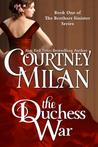
Review: The Duchess War

The Duchess War The Duchess War by Courtney Milan
My rating: 4 of 5 stars

I saw this book recommended on a blog post somewhere which encouraged people who don't read romance to give it a try. I occasionally read fantasy or SF that has a romance plot in it, so I thought I'd see what straight (historical) romance was like.

It's good. The editing is clean, which means I can relax and focus on the story. Romance, as I understand it, is all about the relationship between the characters, and that is certainly what you get here; there are events, but they are there to drive, complicate, or illuminate the relationship.

One problem I sometimes have with romance is that the couple concerned don't seem like attractive people to me. The woman is some combination of weaksauce, stupid, or an emotional mess; the man is a heartless brute; together, they fight crime - I mean, bonk like rabbits. I'm glad to say that was definitely not a problem here. The female lead is clever and determined, level-headed, and generally admirable, though not overly perfect or without problems; she isn't ridiculously beautiful, she has believable emotional issues from her past, and she struggles with the decisions she must make for powerful reasons that made sense for her character and situation. The male lead is kind, open-minded, and respectful of women in general and the female lead in particular; he, too, is messed up by his background in ways that drive the plot. (However, I did think that he made a remarkably stupid decision at one point that teetered on the edge of being driven by the plot rather than making complete emotional sense.)

I flirted with the idea of giving it five stars, but in the end didn't, because just occasionally the illusion slipped, and I was reminded that I was reading something written in the 21st century by an American, but set in 1860s Britain. The most glaring example was when the duke says "that was dumb", something that I suspect very few British dukes would say even today; but there were a few others. I also wondered, and never found out, where the characters got their sex education, and why they appeared to be so comfortable with their sexuality. All of this made it more like watching a play (where you have to consciously suspend your disbelief that the painted backdrop is a drawing room) than watching a movie shot on location. Still enjoyable, but more mental work.

Notwithstanding that, a fine effort, and I recommend it.

View all my reviews

Friday, 6 May 2016

Review: Futuristica: Volume 1

Futuristica: Volume 1 Futuristica: Volume 1 by Metasagas Press
My rating: 5 of 5 stars

Disclosure: I received an advance review copy from the publisher because I have a story in Volume 2.

These are some fine stories, and I'm honestly flattered to be in such good company. Although the authors are not yet well known, I have a feeling that many of them eventually will be.

This is just the kind of science fiction I like: fresh ideas interestingly and competently explored, in a way that leaves you both thought-provoked and emotionally moved (sometimes disturbed). A few are funny; a few are horrific; most of them are just straight-out engaging. When they use tropes, and sometimes they do, they often twist them or mash them up in unexpected ways, and a good many of them combine more than one near-future or current technology trend.

A couple did break my suspension of disbelief. Daryna Yakusha, in "Felis Helianthus", shows us an Internet without cat photos, for example. I'm actually kidding about that one, but Robert Lowell Russell's closing mecha-mercenaries story, "Love That Easy Money", gave me a few fridge moments, and the more I thought about it the more plot holes it seemed to have. That's not to say it wasn't moving, in its own way.

A lot of the stories show us futures where people are struggling, often because of climate change. Megan Chaudhuri's "Sterile Technique", for example, takes themes of vat-grown meat and infectious prions and places it within a story of human struggle, love, family, conflict and working for difficult employers. James Beamon's "Whole Lives in Hammered Fragments" takes tropes that have seen more use than most of those in the other stories - poor asteroid miners exploited by corporations, rebellion of the space colonies against Earth - and does something fresh with them, again bringing family in as a strong theme. Then we get the humorous "End of My Rope" by Holly Schofield, which is literally about herding cats (and space trade with difficult aliens, and intelligence enhancement).

Patrice Sarath's "Murder on the Hohmann" is in the mould of classic murder-on-the-isolated-transport stories, whether that transport is an oceangoing ship or the Orient Express. But it has a clever twist, which takes the mystery trope of "everyone has something to hide that makes them a suspect" in a fresh direction.

L. Chan's "Coin Toss" plays with AI, cryptocurrency and another family connection. Wole Talabi's "If They Can Learn" does something clever with AI training and systemic racism. Both give us nonwestern locales and protagonists, something it's good to see more of in SF.

L. H. Davis's "Shoot Him Daddy" mashes up alien invasion and redneck zombie apocalypse survival, but with a romance element, and does a fine job with tension. Marina Berlin's "Life and Death in the Frozen City" features a courtesan who must make a difficult choice in an occupied country. Anne E. Johnson's "Dreamwire", by contrast, shows us a trust fund princess obsessed with body modification, and what happens when she takes it too far.

Nancy S.M. Waldman's "Hu.man and Best" is set after the end of a robot uprising, and once again brings in themes of family and caring for the young. Ciro Faienza's "The Soma Earth" is a cli-fi story featuring scientific agriculture which touches on racism and the culture of criminal gangs, while Mary Mascari's "Debugging Bebe" does something completely different with scientific agriculture, cultural tradition from a very different place, and social class and privilege.

Mike Morgan's "Something to Watch Over Us" involves half-Japanese people in Japan; AI; and what happens when a corporate wellbeing program works a little too well. It's amusing. So, in a darker way, is Stephanie Burgis's "Mums' Group", with very different protagonists: young mothers in a British city of the fairly near future, also interacting with AIs that are supposed to give guidance for social good, but with an entirely different outcome.

Bo Balder's "Even Paradise Needs Maintenance" crosses the world again to Australia, with downloadable skills, universal income, ocean cleanup, alien trade, remote avatars, and libertarianesque religious states which produce inept terrorists. She runs all those elements through a blender and produces a good adventure story.

E. E. King's "Light-Years from Now" is a lovely first-contact story, set in the present day, with an underlying theme of accepting difference. And Gary Kloster's "Llamacide" is a hilarious tale of brain hacking, which makes the most of the parallel between debugging a program and solving a mystery.

All in all, I'm greatly encouraged that there are so many good stories being written in SF by so many diverse, widely scattered writers. There's plenty of life left in the old field, is the message I take from this collection, and will be for many years to come.

View all my reviews