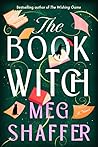
 The Book Witch by Meg Shaffer
My rating: 5 of 5 stars
I thought I didn't much care for metafiction. I'm glad I took a chance on this anyway; it changed my mind.
The problem I've had, I think, is that I'd never previously read a metafiction book that really worked for me as a novel, apart from the premise. Not that you could separate the premise from this one; it's thoroughly premise-driven, which is how I like my fiction. But more than that, it has the kind of reflection on the human condition, on finding meaning in life, and on human relationships that takes a book up to five stars for me. Not to mention reflection on the role of fiction and reading in the lives of book lovers, and how it can be more than just "escapism." (Tolkien's words in On Fairy-Stories are relevant here: "Why should a man be scorned if, finding himself in prison, he tries to get out and go home? Or if, when he cannot do so, he thinks and talks about other topics than jailers and prison-walls? ... In using escape in this way the critics have chosen the wrong word, and, what is more, they are confusing, not always by sincere error, the Escape of the Prisoner with the Flight of the Deserter.")
The whole book is a love-letter to reading and stories, and to the way fictional characters can inspire us and teach us to be better, stronger people in our difficult moments, even in fiction that's usually thought of as juvenile and lacking in literary merit. (There's particular love here for Nancy Drew.) The villains - who are, honestly, a bit cartoonish - are the Burners, people who want to destroy books they think are in some way unworthy to exist, because they're unable to see the merit in them.
They do this by going into the books and wreaking destruction, opposed by the Book Witches, whose goal is to preserve fiction as it is. It's kind of the same dynamic you get in a lot of time-travel stories, where the heroes want to preserve the timeline and the villains want to disrupt it.
The struggle against the Burners, though, isn't the main plot. The main plot is that the particular Book Witch who's narrating most of this book, Rainy March (the absurdity of the name is acknowledged right upfront), has fallen in love with a fictional character, the noir detective known as the Duke of Chicago, and the rules don't let them be together. Also, she wants to solve several mysteries, such as what was up with her mother disappearing for a while, returning pregnant with Rainy, refusing to say who the father was, and dying shortly after Rainy's birth? Also, where has her grandfather, who raised her, disappeared to?
The meta gets multi-layered before the end, with at least four levels of fictionality/reality, and it all contributes to the plot and makes sense, which is a feat in itself.
What boosted it into the Platinum tier of my annual book recommendations was not the assured execution, the well-thought-out reflections, or the appealing characters, including a non-speaking but intelligent cat familiar. Those took it to five stars, but what catapulted it to the top was that it made me feel something genuine, not manipulatively but through depicting a human moment - a funeral of someone beloved for her work and its impact - with empathy and warmth. In fact, I had to read a bit further than I'd intended and delay going off and doing something adult that required me to be in control of my emotions because of that scene. (That's the opposite of a complaint.)
It's one of those books that you want to keep reading, but also want to save because it's so good and you can see that you're getting closer and closer to the point where it stops, and then you won't have that experience anymore.
If you love books because of the way they tell human stories that matter, this is a book you should definitely take a look at. It's a strong recommendation from me.
View all my reviews
No comments:
Post a Comment